
 When my youngest daughter, Kate, was a senior in high school, she was in an advanced writing class. One of her assignments was to write a poem using iambic pentameter. She was overwhelmed by the assignment and wasn’t clear as to what iambic pentameter meant. They had talked about it in class, but most of you will relate to how clear it was by the time she got home. LOL
I want you to know I’m not a fan of poetry, unless it comes from Mother Goose. I’m a bit ashamed to admit it, and I know that I owe it to myself to read some poetry before I die. : ) My daughter, however, liked it a lot. She really enjoyed Shakespeare. She had read all of his works and all of his sonnets, watched many plays, and acted the part of Hero from “Much Ado about Nothing” in 8th grade. Here is another confession- I have read Romeo and Juliet and seen The Taming of the Shrew. That’s it.
So, it wasn’t a happy circumstance when she came to me and asked for help. I had no idea what iambic pentameter was. But how could I say no to my daughter who needed my support? So, we sat at the computer together and began. We looked up iambic pentameter. We read it. We gave each other a blank stare and then read it again. Now I may not love poetry, but I’m pretty good at figuring out what I read. I began to understand and was able to explain it to her. Then she was off and running.
We talked over possible topics for her poem. Then she chose one, which happened to be her own idea. Way to go, Kate. She told me the story she envisioned her poem telling. It was good, really good. Then she wrote the first line. I can see us pounding out the syllables into our hands and changing words until there were exactly ten syllables per line. We would come up with ordinary words and then check the Thesaurus to find words that were more descriptive, elegant, or fitting for the time period and topic. It was fun. We laughed a lot.
She wrote and rewrote for over 3 hours. I was there the whole time. I made suggestions whenever she was stuck on a word or a thought and asked for help. She seldom used the word I suggested, but it would spark her mind, and then she would come up with the perfect word by herself. She would look at me with an excited smile, raise her hand, and say, “Gimmie five.” I would, at regular intervals, say, “This is good; it’s really good. You’re amazing!”
Be With Me While I Write
When Kate was in her first year of college, she took a creative writing class. One assignment was to create an imaginary author and describe his/her life. She was to present a piece of the imaginary person’s writing and then analyze it. She decided to rewrite the poem she wrote in high school about a sailor’s widow. She was adjusting it to tell the story of a Civil War soldier’s widow.
One day, I peeked in her room to say hi and see what she was doing. “Mom, come in and let me read this to you.” I went in, and she read it to me. Then she asked me to sit down and help her out.
We reminisced about the time we worked on the original poem together; all those great feelings came back. We laughed about the experience and how fun it had been.
I sat on the side of her bed and watched her use the Thesaurus and the dictionary to find words she needed. I saw her look up Civil War information and get a feel for the time period. I didn’t say much. Her poem was coming along great. Eventually, I stood up, patted her back, and left her to her work. She didn’t really need me. She had learned through experience what to do.
This is a marvelous example of being present. What Kate had needed in high school, she wanted to feel again while creating her imaginary author and what they would have written. She wanted me to be present, to feel my support, have some of my focused time, and sense my enthusiasm for what she was doing. These are the things all kids need from time to time.
Kate wrote her poem in high school by herself. She thought she was asking me to help her do it. What she really asked was, be with me, care about me, and learn with me. This is Principle Two from The Five Principles of Power – Be Present.
Kate is raising three children of her own, and she understands not only how to write a poem in iambic pentameter, but she also knows how to be PRESENT. Enjoy Kate’s work from her high school days.
It’s now a few decades old, but still wonderful.
The Widow’s Walk
By Kate Johnson
Upon the widows’ walk forlorn, she stands.
Face gray, indistinct in the morning mist.
Iron railing, cold portent in her hands.
Heartache knocks, upon her cheeks he kissed.
Annals of mariner’s wives keeping pace,
Back and forth, eyes on the horizon.
Lives lost forty leagues below without trace.
Possibility, worry like poison.
Bells peal out, mournfully telling of loss,
Belaying her breath, they tacitly mock.
Mind shrouded, forever bearing the cross,
Endlessly trudging the high widow’s walk.
Hope springs eternal; they shall meet anon
Sighs a chantey to a roseate dawn.

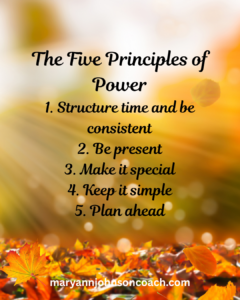 Recently, I wrote about principles that I consider powerful for a healthier and happier family life. Last week, we delved into principles one and two. Today, I will share information and examples on principles three and four.
 I have had this recurring thought in the last five years – “Why are you writing? You aren’t raising kids anymore. You aren’t homeschooling. You’re getting older. Are you even relevant?” Then I get an email from a young mom thanking me for helping her see what she couldn’t see, or from an older mother or grandmother thanking me for reminding her of what she already knew.
 My husband was watching the show The Irrational. It’s about a behavioral science professor who solves tough police cases. I was in the kitchen and could hear it. The main character had an appendix surgery. He tried to rise from his bed a few times because there was a case he wanted to get going on. His sister had to nag at him to remain in bed and heal. At one point the professor spoke with a priest, while still in the hospital. The priest said, “St. Stillness has visited you.” Then he smiled and the professor replied, “Oh, stillness. I’m not very good at it.”
 I like Kerry Patterson. He is a great writer and from my era, so I relate to everything he writes. Back in September 2012, Kerry

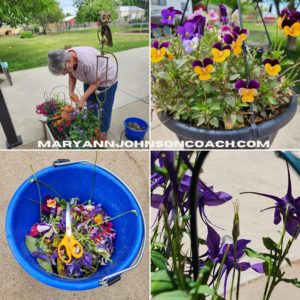 didn’t need to pluck each blossom and give it away, but when a bloom was finished and began to droop, you clipped off the head so that it couldn’t produce seeds.


 Wise people seek wise counsel.
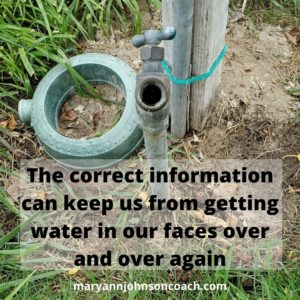 The other day when I went out to water the garden,
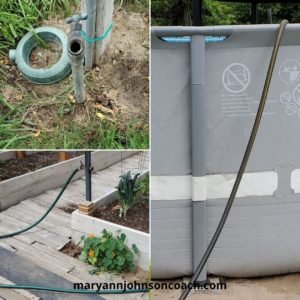 the same thing almost every day. First, I walk out to the back faucet and turn on the water. Then I go through the garden gate and turn on the second faucet which lets water into the garden.
 When we moved with Jodie’s family this last time, we had to build a kitchen for my family, where a storage room had been. Everyone tried to talk me out of the light I choose to go over the kitchen sink. After all, it was a bathroom fixture. I didn’t care, I loved how it looked, and it was so illuminating. Every time I use that light, I am amazed at how much better I can see. The odd thing is that I don’t always use this extra light. Sometimes I will be washing potatoes or doing dishes and think, “I have enough light.” And I do, sort of. Then I will have a change of heart and flip the switch that is right in front of me, and voila! I can see so much better. There are other times when I know that I need more light, and I hurriedly flip the switch. I am always shocked at how much better I can see and how much more efficiently I can do whatever job I am doing because the details are more apparent.
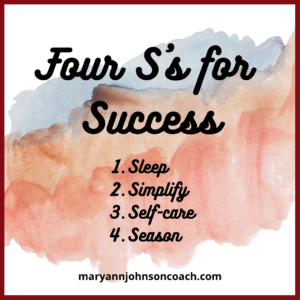 I gave up New Year’s Resolutions many years ago. I always felt set up for failure. I have found it more useful to periodically evaluate how I am managing my life, how I am feeling about it, and what simple adjustments I could make so that I fare better. I emphasize the word simple. I also keep the list short! I want success and not overwhelm.
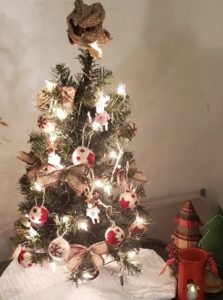 one on Dec. 30. This Christmas, both sets of parents pondered what to
 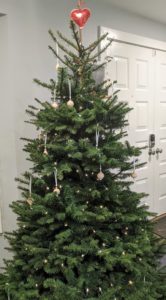 do about their Christmas trees. They have older children. They like their homes to look festive. In the end, they adjusted for the season they are in. One kept all the ornaments on the top half of the tree. The other had a very small tree on a tabletop. It isn’t what they love or do every year, but it is what they did this year. Your season matters and when you honor the season you find yourself in, things feel more peaceful. They could have spent the whole season spanking baby hands or grieving over broken family mementos. But they choose to respect the season their family was in.