 Intriguing title isn’t it.
I read an article comparing play-based curriculum with skill-based curriculum but what I found interesting were the points it made about the value of play for all children and the benefits of play-based curriculum, for those children who are in the public school realm.
In the world of education, there seems to be a bit of controversy about letting children play, when, where, how much, and with what. I think that is partly due to the end-driven results that we adults seek. We let our children play but what is the end result, what is the purpose. No willy-nilly free play for our children. And for goodness sake don’t play too long or too loud or too messy or too…
Coming from a far different era I am often amazed at this thinking. I cannot tell you all the days that I spent aimlessly playing, by myself, or with a gaggle of friends of mixed ages. No one ever thought a thing about it.
I wrote an article about the power of play in helping a child build complex, skilled, responsive, socially adept, and cognitively flexible brains. I loved this quote. “For most of human history, children played by roaming near or far in packs, large and small. Younger children were supervised by older children and engaged in freewheeling imaginative play. They were pirates and princesses, aristocrats, and heroes. But, while all that play might have looked a lot like time spent doing nothing much at all, it actually helped build a critical cognitive skill called executive function.” That describes my era perfectly and the value we gained from this freewheeling play.
Let me share some of the insights from the article with you because I think you will find them interesting too. I hope they get you thinking about your children’s need to play, in order to learn important skills.
“Every day where we work, we see our young students struggling with the transition from home to school. They’re all wonderful kids, but some can’t share easily or listen in a group. Some have impulse control problems and have trouble keeping their hands to themselves; others don’t always see that actions have consequences; a few suffer terribly from separation anxiety. We’re not talking about preschool children. These are Harvard undergraduate students whom we teach and advise. They all know how to work, but some of them haven’t learned how to play.”
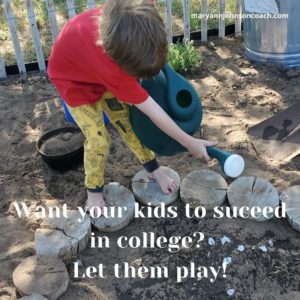
“If you want your child to succeed in college, then play-based curriculum is the way to go. Why do this? One of the best predictors of school success is the ability to control impulses.” (Isn’t that exactly what I said in my article on executive function?)
“The beauty of a play-based curriculum is that very young children can routinely observe and learn from others’ emotions and experiences. One randomized, controlled trial had 4- and 5-year-olds engage in make-believe play with adults and found substantial and durable gains in the ability of children to show self-control and to delay gratification. Countless other studies support the association between dramatic play and self-regulation.” (I might mention here that in my opinion, child-initiated play without adults would cause even more substantial gains than adult-directed play!)
“Through play, children learn to take turns, delay gratification, negotiate conflicts, solve problems, share goals, acquire flexibility, and live with disappointment.”
“As admissions officers at selective colleges like to say, an entire freshman class could be filled with students with perfect grades and test scores. But academic achievement in college requires readiness skills that transcend mere book learning. It requires the ability to engage actively with people and ideas. In short, it requires a deep connection with the world.” (I say, they know how to think!)
“For a five-year-old, this connection begins and ends with the creating, questioning, imitating, dreaming, and sharing that characterize play. When we deny young children play, we are denying them the right to understand the world. By the time they get to college, we will have denied them the opportunity to fix the world too.”
So, when you are considering how to let your children spend their time, think deeply about play. Think about what toys and materials accentuate play. Observe your children when they play. Consider the effects of video and television on play. Make time for plenty of play. Ask for spiritual guidance as you make your decisions about play. For me, reading this article on the importance of play reaffirmed what I knew as a child.
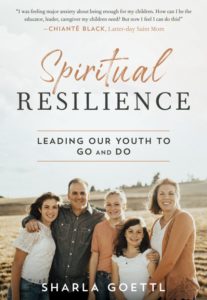 So, I am delighted to introduce you to a new book by Sharla Goettl, Spiritual Resilience: Leading our Youth to Go and Do. It is an excellent resource for any parent who is also a member of The Church of Jesus Christ of Latter-Day Saints ~ or who lives a Christ-centered life.
 loss difficult. His back and hip make exercising a challenge. He has been experimenting for months and finally came up with a way to move forward that he felt he could do
 I have a photo of my daughter Jenny who is in her forties. It was taken when she was around six. Recently, I was looking at it and experienced a very tender moment. In those early parenting days, I loved my children. However, this photo reminded me that at that busy time of life I did not realize how sweet and precious they were; that the opportunity I had been given to be their mother was not just a responsibility or a job, but a gift, one of the greatest.
 parented. I was driving across our small town and was miraculously alone. Off to my right, as I glanced down the street, I saw a small girl skipping along towards me. I saw her sweet little face and feet as she firmly planted each step. Then without warning, I saw that child as I had never seen another human being. It was as if she was clothed in a light that had previously been hidden from me. It was overpowering and I cannot express the feelings that filled my heart. I began weeping. I had seen the beauty of another human being. She was far more beautiful and precious than I had ever imagined any person could be. It was a gift to help me on my way.

 Five years ago I became my granddaughter Maggie’s aid at school.
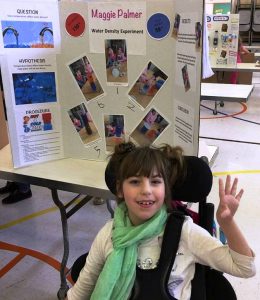 child” surprises me. How could stepping on such a little thing hurt so badly? I shake my head in wonder as the tears flow. Just the other day one of Maggie’s little next-door friends said to me, in her frustration of not being able to play with Maggie in ways that she wanted to, “I wish Maggie didn’t have cerebral palsy.” Her comment sucked the air out of my lungs, and I was speechless. What should I think about this, about her? I didn’t know.
 A Sherpa has come to be known as someone who guides another along a challenging journey. A Sherpa takes upon themselves the heaviest burdens of the expedition. A Sherpa understands their traveling companion may be inexperienced, awkward, and fearful as they walk through territory that is not their native country, and they are patient with that.
 Jodie is the mother of four children, ages 5, 8, 10, and 12. Her oldest daughter, Maggie, has severe cerebral palsy. Although her energies are focused on the busy season of raising a young family, she is also a writer, teacher, mentor, and coach. She has spent many years helping parents create their own unique vision, master plan and custom-made systems for the education of their family. She is also the past president of the Midwives College of Utah and currently serves as a member of their board of directors and a personal student mentor. Jodie’s secret wish is to ride cross-country on a motorcycle in black leather pants.