
 Several years ago, I read an enlightening article by Wallace Goddard on bringing up and teaching children with compassion.
I frequently talk about “seeing children with new eyes.” Mr. Goddard calls it “seeing them with compassion.” When we feel compassion for our children, we are gentle with their efforts to learn and the mistakes they make in the process. I talked about the value of children’s mistakes in last week’s article.
There were two stories in the Goddard article that demonstrate the power of softness over hardness in our relationships with our children. They are also instructive as to the power of gentleness upon our ability to teach.
I Don’t Like VanGogh
The first story is about Anjelica Huston and her famous father, film director John Huston. At the dinner table one evening, Anjelica remarked, a bit flippantly, that she didn’t like van Gogh. Her father challenged her to “name six of his paintings and tell me why you don’t like them.” She couldn’t. He sent her from the table and told her not to come back with her opinions until she knew what she was talking about.
John responded to Anjelica’s ill-informed remark with strong correction, but no compassion. Goddard pointed out that when we correct without gentleness and love, we do not enrich and educate people; we enrage them.
Representational Art, Really
The second story comes from Haim Ginott, a Jewish immigrant to America who wrote about replacing hardness with softness in parenting. He taught about compassion in his book Between Parent and Child. Although published in 1965, it is widely recognized as a foundational text and has had a lasting impact on parenting.
When Ashley, age fourteen, criticized modern painting, mother did not dispute her opinion. Nor did she condemn her taste.
Mother: You don’t like abstract art?
Ashley: I sure don’t. It’s ugly.
Mother: You prefer representational art?
Ashley: What’s that?
Mother: You like it when a house looks like a house, and a tree like a tree and a person like a person.
Ashley: Yes.
Mother: Then you like representational art.
Ashley: Imagine that. All my life I liked representational art and didn’t know it.
Contrast this gentle approach with the one described earlier in which John Huston reacted to Anjelica’s statement. Huston’s response was to humiliate. Ashley’s mother’s desire was to educate. When we respond to children with compassion, that is the difference it makes. It is compassion that helps us see with new eyes. And when we see with new eyes, we can better help our children love learning.
Compassion Doesn’t Only Show Up In Big Moments.
Sometimes it’s as simple as a load of laundry. One day my grandson, Ben, came and asked me if I could help him do his wash. He had been doing his own laundry for some time, but he had an appointment and needed someone to put his clothes in the dryer because there was an item he needed after his appointment. I told him I could. As he loaded the washer and put in the soap, I noticed there was a setting he needed to change. He wasn’t aware of it. I said, “Ben, your washing will come out much cleaner if you change this setting.” He looked amazed and said, “Gee, thanks, Grandma. I didn’t know that.”
Since Ben had been doing his own laundry for a while, and I know his mom taught him how, I could have made him feel less capable by pointing out what he had done wrong. Instead, I showed him how to make it even better.
This issue of teaching and responding with compassion comes up for me every day as I work with my 96-year-old mother, who has dementia, and my husband, who is doing his best to manage his health. Add that to the needs of the grands I live with. : ) I sometimes respond wonderfully, and at other times I look back and think, “Why were you so hard?” I don’t beat myself up when I mess up. What I do is review how I responded and how I could have. Then I move on.
Compassion is a skill we can all learn, and it takes time. If we are aware and want to get better at it, every day offers practice: a child’s question, a mistake, a mess, a loved one who needs more patience than we thought we had. Each time, we get to choose softness over hardness. And when we miss, as I do, we can offer ourselves the same gentleness we are trying to give them. Review, learn, and try again.
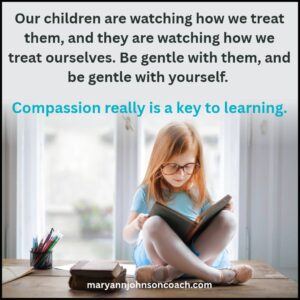
Our children are watching how we treat them, and they are watching how we treat ourselves. Be gentle with them, and be gentle with yourself.