Category: Children learning skills

Stop Fixing the Cookies!

When you’re engaged in a project, what matters to you? For many adults, it’s the outcome. We want the cookies to taste good, the tomatoes to grow large and red, the dress to look store-bought, and the painting to be perfect. I know that doesn’t apply to every adult, but it does apply to many of us.

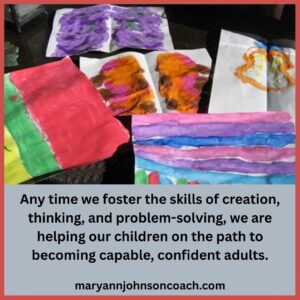
When children are engaged in a project, what matters to them? For the most part, it’s the process. Have you ever watched a five-year-old paint? They like digging the brush deep in the paint and swirling it around. They like lots of paint on the brush. Then they swipe it onto the paper. They smile at the brightness of the color. They aren’t usually concerned if the red bleeds into the green or if the red turns the yellow a tad orange at the edges. It’s the act of painting they care about. And when it’s done, no matter how it turned out, they are happy and proud.

We can increase our joy when working with children if we let go of the outcome. The act of creating is what children love. It’s what makes learning fun. Our job is to provide the materials and the inspiration. Theirs is to create the outcome.

A Party is a Perfect Venue

Any time we can encourage creative exploration, we are on the path to helping our children gain confidence and learn new things. Even a child’s party is a perfect venue for allowing a child to create without worrying about the outcome.

My mom gave me some amazing parties. I recall that in my seventh-grade year, I had a taffy party. I had seven or eight friends over, and my mom taught us to make pulled taffy. It turned out well. It was so much fun. We had a really good time, and each girl had a gift, a plate of taffy, to take home. My mom showed us what to do and then stood back and let us do it.

I followed my mom’s footsteps. One year we had a dress-up party. I collected dress-ups from thrift stores, and when the children arrived, they each designed an outfit. Then we had a wonderful parade around the block. I supplied the materials, and the kids did the rest. I didn’t help them put their outfits together. The outcome wasn’t the priority; creating was.

Another time I helped the kids make sugar cookies from scratch. They frosted and decorated them with small candies, raisins, and other edible treats. Then the cookies were packed into small boxes to take home. I didn’t fix any cookies that didn’t look perfect. It was tempting because what their parents would see might reflect on me. But I shut out that story and let the kids create.

When my youngest daughter was turning eleven, we had a formal tea party. The guests came in their best dresses and were served by mothers who had been enlisted to help. The ice cream was cut into little teapots using a teapot cookie cutter, and each girl had her own miniature cake. They were encouraged to converse. The other moms and I made ourselves scarce and allowed the girls to figure out how a tea party worked. They got the hang of it, and soon there was an ample amount of giggling and chatting going on in the living room. Each girl went home with a miniature tea set purchased at the dollar store. Kate said it was her favorite party.

One year my son had a relay party. All the activities were relay games. We found lots of ideas by asking his grandparents about games they remembered, games I recalled from my school days, and books from the library. The instructions were given, and then the adults sat on the sidelines and let the kids hash it out. They had a wonderful time.

What Would I Do Differently?

Although I stood back and let the children at the party do their thing, here is what I would have done differently if I could go back. I put together wonderfully creative activities, but I did all the planning, just as my mother had done. Wouldn’t it have been a great learning and growing experience to sit down with the birthday girl or boy and plan it together? I bet often they would have loved my idea. Occasionally they might have had a completely different idea, which would have required me to step back and change course, not always an easy thing. But doing that would have helped them work on skills they would need as adults, rather than just showing up at a party and having fun. Think of all the learning that could happen when a child and parent plan something together.

There is real value in stepping back and allowing our children to create without worrying about the outcome. I once read that the greatest teachers replace themselves. When children feel courageous and excited to venture out, learn new things, and then use what they’ve learned to bring joy to others, that’s something worth celebrating.

Any time we foster the skills of creation, thinking, and problem-solving, we are helping our children on the path to becoming capable, confident adults.

The Education Adventure – Be an Example & Remember the Spark

I mentored parents for many years. I enjoyed this work, the friendships I made, and the changes I saw in families. In the early days, I worked with families that were homeschooling. Later, I added parents who educated their children in private and public schools. One of the issues for all parents was how to help children/youth want to learn, enjoy the process, and take responsibility for their learning. No one system insulates parents from this dilemma. I began writing a series of articles titled The Education Adventure. These articles contained real experiences, from real families. Their stories are helpful when working to help children take on the adventure of education.

Important Questions

These are two questions that often surfaced while mentoring. The answers vary widely from family to family and from child to child. Observing how other families manage can assist in answering these questions for your family.

• How do you help them want to learn?
• How can you help children/youth take responsibility for their learning?

An Example from a Real Family

I had the privilege of working with a family who had an 11-year-old boy. Let’s call him Mike. They homeschooled. But as many of us do, even when our kids are in public or private school, mom pushed him. She wanted him to succeed. She wanted him to be proud of himself. Every day there was a lot of math, reading, spelling, science, etc.

This doesn’t sound much different from the mom who is using a private or public school, does it? At the end of the day, we feel responsible for how our children are doing in their schoolwork. It often feels as if the quality of their work shines a reflection on us, as parents. Are we helping them enough? Are we making sure they’re getting their homework done? Are they enjoying the education process? Do we feel overwhelmed with their school stuff and all the other things we manage?

Back To The 11-Year-Old

Mike had become somewhat belligerent about schoolwork, especially math. When his mom reached out to me, she didn’t think her son liked school. I was able to share information on how to make it feel more enjoyable and gave her some tools. They were helpful to her children, but we really made significant progress when I met with her son.

When I asked Mike how he was feeling about school, he said he liked it. He liked doing things as a family. He enjoyed reading together and alone. This surprised his mom. I asked him how he felt about math. He said he loved it; it was one of his favorite things. This also surprised his mom. Then I asked a pointed question, “Then why do you fuss about doing your math?” He responded that sometimes he wanted to read instead. I had to laugh. Doesn’t that sound like all of us? Sometimes you have things you need to do, but you want to do something else, and it makes you feel grouchy. It’s one of the reasons my daughter, Jodie, lets her kids take an occasional ‘sick’ day. : )

Since math had been the big issue between him and his mom, I asked him why he loved math. He replied that he liked working things out and solving problems. I said, “Then you would probably like architecture. It uses math to solve problems and work stuff out.” He said he loved architecture. This was something his mom hadn’t known. She had never talked with him about his math, except to ask if his assignments were finished. That week, she got books on architecture from the library and set them out. One day, they spent time together looking at pictures of famous buildings and talking about them.

Here’s another hard place many parents find themselves, as Mike’s mother had. We know what needs to be done, but we aren’t watching our children to see what interests them. We aren’t engaging in conversation. We’re not listening. We’re busy with life, and we want them to get their schoolwork done and do it well. However, when we ask questions and respond to what interests our kids, we help them connect schoolwork to their goals and dreams.

Mike’s mom and dad attended a seminar I spoke at a few weeks after we began working together. We had a conversation about their son and his math. Just that day, he had gotten mad at his mom over the math homework. He didn’t want to attend their family devotional or participate in family reading. He accused his mom of making him get behind in math because of all this other, unimportant family stuff.

I listened as the parents talked about the situation, and then I asked, “Why are you taking responsibility for Mike’s math?” His parents weren’t sure how to respond. I mean, don’t all parents manage their kids’ education and make sure they do the work?

At our interview, I asked Mike how he felt about overseeing his education, about being responsible for whether he learned math. He said he liked being able to choose what to study every day, but worried about being in charge. He said, “Sometimes I like having someone tell me what to do. It’s scary feeling I’m in charge.” Here he was fussing when his mom told him what to do, but he was intimidated by managing himself. This is the lesson everyone must learn, at some point, to live successful lives. It’s wise for kids to practice being responsible before starting high school, leaving home, or going to college. His mom saw that we can’t (and shouldn’t) do it all for our kids. They must learn to take responsibility. I’m watching this unfold in my own home this year with one of my teenage grandsons. Accepting responsibility is not always easy.

Let me share a powerful quote from an old friend, Oliver DeMille. “Freedom is the powerful, essential ingredient required for the development of courage. Students may become comfortable with being told what to learn and when to learn it. They may feel some fear or insecurity when offered the opportunity to choose. They may require time to engage in study of their own choosing. There is nothing more powerful for a child…than a loving and concerned mentor who frequently displays the courage to try, the courage to learn new things, the courage to endure as they struggle to acquire new skills and to flex mental muscles they didn’t know they had. Gentle invitations can be made for children to come along in the great adventure of education.”

I’ve written about the importance of parents continuing their own education (this can be in community classes, higher education, or good old-fashioned reading) because it builds confidence; confidence that the parent can learn and be an example to their family. It builds confidence in the child that they can learn by following the example their parents are setting for them. Parents need to model the behavior they want to see in their children.

I’ve also written articles on the value of seeing children’s sparks, what they are truly interested in, and how responding to those sparks can ignite a love of learning, which carries over into subjects they aren’t as passionate about. This is successful in all types of educational systems.

Ask Questions, Listen, & See the Spark

It’s hard to see sparks if we aren’t talking with and listening to our children. Mike loved math, but the only conversation he had with his parents about it was whether he had finished the worksheets. Think of all the wonderful ways this spark could be used to spur his desire to learn math on his own, to take responsibility for his education. His mom had followed up by getting books, and they were planning to visit an architect’s office to see what an architect does.

Sparks and your example are two things that can make a difference in your child’s personal education. You are the mentor for your children, regardless of where they attend school. It’s hard to convince your child that education matters if you’re not somehow engaged yourself. We can only invite our child to join us in the great adventure of education if we’re taking that adventure ourselves.

Remember what Dr. DeMille said, “There is nothing more powerful for a child than a loving and concerned mentor who frequently displays the courage to try, the courage to learn new things, the courage to endure as they struggle to acquire new skills and to flex mental muscles, they didn’t know they had. Gentle invitations can be made for children to come along in the great adventure of education.”

So, learn to tie fishhooks, learn cake decorating, take up Spanish, begin sewing, attend a community education class, or have a book in the bathroom that you read daily. Let your children see you learning. Talk to them about the challenges and joys, and they will begin to share their feelings with you. This makes for great dinner conversations. When you make this effort, it can ignite a love of learning and a desire to take responsibility. I’ve seen this work over and over again.

What will you learn or read next?
Learning Play – Creating a Rain Stick

The Spark

I was watching Jack, almost 3, and Mary, who was 10 months old. It was getting crazy. I was trying to write an article and keep the Christmas Tree from tipping over for the third time that day. I began asking myself, “What can I get Jack interested in?” We have a large rain stick in the living room, so I got it out.

Jack was fascinated. He tipped it upside down many times to hear it “rain”. I asked him if he knew how the rain stick worked. He didn’t. So, I used my fingers to explain how there were crossed spines inside and small seeds. When the seeds hit the spines, they made the sound. I could see he was a bit confused.

Figuring It Out

“Jack, do you know what a cactus is?” “No?” “I’ll bet we can find one on the computer.” (I didn’t have any books on cacti in my library.) We went to the computer and pulled up some pictures of cacti. I explained that when the cactus dies, the arms can be made into rain sticks before they dry. I showed him some cacti with long spines and explained that the spines are pushed into the dead cactus. We got our rain stick, and I was able to let him feel the ends of the spines in the stick.

With Jack on one knee and Mary on the other, we googled making a rain stick. The first thing up was a video series showing how to make a rain stick from a cardboard tube. We watched the video on how to choose a tube. We watched how to insert the spines, which were made of nails, pins, or toothpicks. We watched the first part on covering the tube ends, and finished off with the video on what to put inside.

Jack was fascinated and watched all the videos. He didn’t get bored or wiggly. I helped him stay tuned in by having mini-conversations. “Look, Jack, there are three lengths of tubes. Which size would you choose?” “Hey, look, she is using nails and a hammer. You would like to hammer nails, I bet.” “See those toothpicks, they would make a really different sound.” It went on and on, and he was fully engaged with how it was done. (The hardest part so far was keeping Mary’s hands busy and off the keyboard!)

Creating Our Rainstick

“You know what, Jack, I’ll bet we can make a rain stick.” “Yeahhhhh”, he said. We pulled out our really great junk box and found a long tube that we thought might work. I handed it to Jack, he put it up to his eye and said, “Hey, it’s my looker looker”; so much for the rain stick. LOL

We took our tube, some straight pins, and duct tape to the kitchen. Jack was content to watch me make the rain stick. He tried pushing in a pin, but decided it hurt his thumb. We talked about dead cacti, thorny spines, and rain sticks while I pushed in pins and taped on an end. Jack chose red lentils and rice to put inside.

He was interested in how the spines looked from the inside of the tube. He understood now what I had been showing him with my fingers, and he showed it back to me. Then I taped the other end and covered the whole thing with duct tape. A rain stick is normally covered with paper or cloth and then painted or decorated, but I wanted to be sure those pesky pins didn’t come out.

Jack excitedly turned it over. It didn’t “rain”. There was just a spattering thunk. Hmmmmm. He tried it a few times. Then he looked at me and, with a serious face, said, “It’s too little,” (meaning short). He had figured out that there was no rain sound because the tube was too short. Amazing! Aren’t children smart?

I told him that we could construct a rain stick out of three toilet paper tubes taped together. He was all for that and rummaged in the junk box for the tubes. Then his enthusiasm waned. He and Mary busied themselves with trucks on the living room carpet while I taped the tubes together. Then I called Jack in and told him I was going to use toothpicks this time and showed him how it would work. Then he was off again to Mary and the trucks. I finished the tube and called Jack in to put the rice inside. I finished taping the ends and covered them with duct tape. Then I called Jack, and he gave it a try. His face beamed when it “rained.”

When his mom returned home, he showed her the rain stick, and I explained about the dead cactus. She said, “Jack knows about cacti. Remember the story about the boy and his bottom.” A wide grin spread over Jack’s face as he recalled the Dr. Seuss story about a boy who sat on a cactus. Now it all came together in his mind.

It was a great time and took only about forty minutes from start to finish; just a mere 40 minutes, and Jack learned so much and had a lot of fun. Then I went back to my article, and Jack and Mary played with the trucks till their mom got home.

Helping children LOVE learning is about catching a spark from a child (in this case, seeing Jack’s interest in the rain stick), then responding.

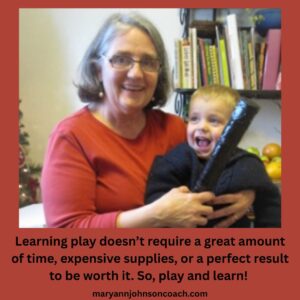
Learning play doesn’t require a great amount of time, expensive supplies, or a perfect result to be worth it. So, play and learn!

Nurturing Leadership Skills in Children: Parent-Led Approaches

Image by Freepic

Today, I’m sharing an article written by my friend, Laura Pearson. I’ve watched my daughter, Jodie, do much of what Laura has shared in this well-written article, so I can appreciate the value of the counsel. I know this information will be helpful to both you and your children. Enjoy. : )

Leadership isn’t reserved for boardrooms or political arenas—it’s a skill set that can begin forming in the sandbox, the classroom, and the kitchen table. Parents hold a unique position to influence this growth, helping their children learn how to inspire others, take responsibility, and navigate challenges with confidence. By embedding leadership opportunities into everyday life, you can set your child on a path toward self-assured, compassionate decision-making. Below are a handful of approaches that blend warmth, guidance, and practical skill-building.

Encourage Initiative and Exploration

Kids often need permission to take the first step toward independence. That could be proposing a new family game night, organizing their school supplies in a way that works for them, or even trying a recipe without help. Letting kids make decisions safely builds their sense of agency while allowing you to provide a safety net. The goal isn’t to shield them from every challenge, but to create opportunities where their choices have visible outcomes—good or bad—so they can learn to weigh options, predict consequences, and adapt. These low-risk leadership opportunities help them grow more confident.

Demonstrating Leadership Through Continued Education

One of the most impactful ways to teach leadership is to demonstrate that growth is a continuous process. Enrolling in various nursing bachelor’s degree options not only opens doors for your own career but also sends a clear message to children about the importance of dedication and self-improvement. Balancing coursework with family and professional responsibilities models perseverance, strategic planning, and the ability to prioritize effectively. It shows that leaders are willing to challenge themselves, adapt, and commit to long-term goals. When kids watch a parent work hard to achieve something meaningful, they learn that leadership is as much about action as it is about aspiration.

Embrace imperfection and accountability

Many children equate leadership with being flawless. In reality, good leaders are willing to acknowledge mistakes and learn from them. If your child forgets to bring their homework home or mishandles a group project, resist the urge to rescue them immediately. Instead, focus on talking openly about mistakes with empathy—yours and theirs. Sharing a time you made an error, how you fixed it, and what you learned reinforces the idea that accountability is a strength, not a weakness. This approach normalizes imperfection, helping them see that growth often happens in the recovery process.

Foster Resilience Through Real Ventures

Nothing builds resilience quite like pursuing a challenging goal in the real world. Encourage your child to test their skills outside of home and school, whether through a bake sale, a neighborhood dog-walking service, or a charity fundraiser. When you support young entrepreneurs’ real ventures, you help them develop persistence, creativity, and the ability to troubleshoot under pressure. Even small projects can teach budgeting, customer service, and time management—all vital leadership skills.

Build Communication, Teamwork, and Critical Thinking

Leadership isn’t just about making decisions; it’s also about working well with others and thinking clearly under pressure. Sports teams, school clubs, and volunteer projects all offer ways in which teamwork strengthens communication skills.  These experiences train them to lead by collaboration, fostering an environment where everyone feels heard and valued.

Allow Choice and Agency Without Fear of Failure

One of the hardest but most valuable lessons for young leaders is that failure isn’t final—it’s feedback. Whether picking a science fair topic or organizing a small group activity, let them own the process. Letting children learn from failure builds resilience and encourages them to take thoughtful risks. Your role is to guide reflection afterward, helping them identify what worked, what didn’t, and what they’d try differently.

Nurturing leadership in children doesn’t require grand gestures or specialized programs. It’s about weaving responsibility, agency, and empathy into the fabric of everyday life. By modeling strong values, encouraging initiative, embracing mistakes, supporting real-world challenges, fostering teamwork, and allowing room for failure, you equip your child with skills they’ll carry into every stage of life.

Leadership, after all, begins at home—one choice, one conversation, and one opportunity at a time.

Discover transformative insights and practical tips for busy parents at Mary Ann Johnson Coach, where meaningful conversations and learning experiences await!

If you like this post and think it would bring joy to a friend, please share it.