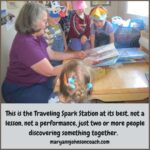
 Welcome back. If you read Part 1, you already know that the Traveling Spark Station isn’t about content — it’s about being present. It’s about showing a child that the person standing in front of them finds the world interesting and wants to explore it together.
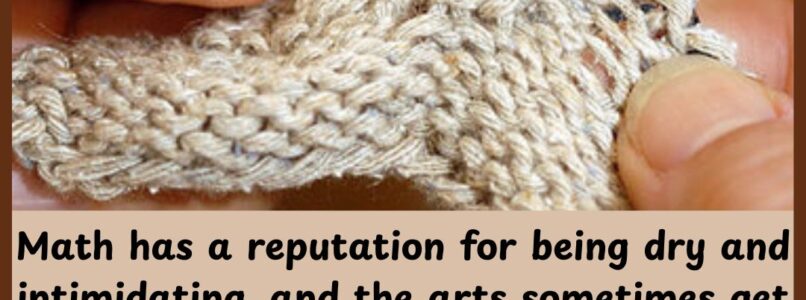
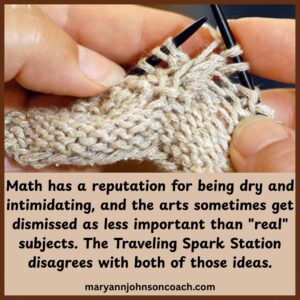
In Part 2, we’re going to explore two areas that might surprise you: math and the arts. I say “surprise you” because math has a reputation for being dry and intimidating, and the arts sometimes get dismissed as less important than “real” subjects. The Traveling Spark Station disagrees with both of those ideas.
Math is everywhere — in the cookies you’re counting out, the nails you’re hammering, the fractions in a recipe, the shapes on a walk around the block. When you make math real and connect it to something a child already loves, it stops being a subject and starts being a tool. And the arts? Creativity, imagination, and making things with your hands are among the most powerful ways children (and adults) make sense of the world. From crocheting white blood cells to building fairy houses in Yellowstone, you’ll see exactly what I mean.
Pack your basket. Let’s keep going.
MATH
1. Learning Our Numbers
One Traveling Spark Station day was designed to help my littlest grands get more comfortable with numbers. Maggie already knew her numbers from 1 to 20. Jack could count to eight — really fast, which mattered a great deal to him — but he couldn’t yet point to items one at a time and count them individually. Mary couldn’t talk yet, but she could count in her own way.
We played number recognition games, tried some dot-to-dot pages (which produced a lot of laughs), worked on counting worksheets, and made a number caterpillar from circles of construction paper. And of course, there were books. There are always books.
2. Giving Math Meaning
People often ask how to get children interested in math. My answer is always the same: find something they already love that uses math and start there. Enjoyment of math has everything to do with inspiration.
I once came across an experience in Stephanie Pearl-McPhee’s book ‘At Knit’s End’ that stopped me in my tracks. She had struggled with math in school, but when she discovered knitting, everything changed. She wrote that the very computations that had made her miserable in math class became completely worthwhile the moment they helped her knit. She wondered why no one had thought to teach math through knitting in the first place.
Math is in games, puzzles, building projects, cooking, shopping, and sewing. Pay attention to what your children are drawn to, and you will find math hiding inside. Help them find it there first, and they will discover that math can be fun.
3. Math Through Carpentry
Carpentry is one of the best math teachers I know. Counting nails, measuring boards, understanding angles and geometric shapes — a simple building project teaches more than it appears to. Two books I found and loved are Carpentry for Children and Housebuilding for Children, both by Lester Walker. They work beautifully for kids, teens, and adults alike. It was a joy to help my son make a stool as a gift, and later to do the same with my grands.
In my Traveling Spark Station, I kept simple carpentry projects for the littles — counting nails and hammering them into a tree trunk, counting each one again as it went in. Simple, hands-on, and genuinely fun.
4. The Periodic Table
I discovered a game called Elementeo, created by a fourth grader, that teaches the concepts behind the periodic table. Since I never took physics or chemistry, this was new territory for me. I found a fun video about the periodic table made for kids, and together my grands and I introduced ourselves to the fundamentals. None of us knew much going in, and we all came out knowing more. That’s one of the quiet joys of the Traveling Spark Station — you don’t have to be the expert. You just have to be willing to explore.
5. Geometry Through Shapes
I was interested to learn that my struggles with math might have had less to do with ability and more to do with a lack of early experience with shapes and spatial relationships. For young children, shapes really are the building blocks of mathematical understanding. As author Carolyn Brunetto puts it, many children grasp abstract math concepts far better through physical experience than through drills.
So, one day, the Spark Station arrived full of shapes. We looked at a wonderful book called Shape Capers by Cathryn Falwell, whose pictures were so inspiring that we simply copied them and made our own shape creations. We made a shape boat, created a chart of shapes to look for on a neighborhood walk, played a shape-naming game, and had shaped snacks — oval hard-boiled eggs, rectangular crackers, and circular oranges.
The highlight of the day came when I showed Jack that two half-circles make a whole circle, and that two triangles make a diamond. He did it over and over, genuinely amazed each time. That kind of wonder is exactly what the Traveling Spark Station is for.
6. Patterns and Mathematical Reasoning
A library visit one afternoon turned up so many wonderful math and pre-math books that I couldn’t leave without them. We used them as a jumping-off point to explore patterns and the concept of same and different.
I didn’t have pattern books specifically designed for very small children that day, so we made up our own activities — looking for patterns around the house, in the wallpaper and carpets, and making a caterpillar from colored construction paper circles. Everyone loves using glue. We then turned to same and different, using a book called ‘Same, Same’, which introduced items that looked different but shared something in common — stripes, size, or purpose. We played sorting games with puzzle pieces, toys, and household objects. The children had no idea they were doing math. They thought they were just having fun. They were right.
7. Math in Everyday Life
Fractions didn’t become real to me until I learned to cook. At school, they were enemies on a page. In the kitchen, making pies, they became friends I needed. That shift — from abstract to real — is everything.
Carpentry teaches algebra and geometry without ever calling them that. Sewing teaches measurement. Shopping teaches value and budgeting. When my Traveling Spark Station includes baking supplies, I talk through every measurement with my grands out loud: “We need one cup of flour — that’s a whole cup. Now we need half a cup of butter, so we only fill it halfway. We need one teaspoon of vanilla, but we’re making two batches, so we need two teaspoons.” A real “I am doing it” moment is the best story problem there is, and you can take that kind of learning anywhere.
8. Math for Preschoolers
The Traveling Spark Station visited preschoolers often, and math was always welcome there. Young children need a great deal of doing and saying before written numbers make any sense to them — and the good news is that preschool math requires no textbooks, no workbooks, and no special equipment.
Here is a conversation I had with three-year-old Jack one afternoon. I asked him to get six cookies. He counted out four and told me he had three. We laid them out together and counted — one, two, three, four. “You have four, Jack, but we need six. That means we need two more.” He got two more, we laid them alongside the first four, and counted all the way to six together. Then we did the same with marshmallows and M&Ms. He was learning to count with real objects in his hands, and he was perfectly happy the whole time.
We also sorted socks, put away groceries by category, made patterns with buttons and beads, and looked for patterns all through the house. The kids didn’t know they were learning math concepts. They thought they were just spending time together. And that, of course, is the whole point.
ARTS, CRAFTS & IMAGINATION
1. The Family Reunion Traveling Spark Station
Every other year, my Spark Station travels to our family reunion, and this has been going on for several decades. Reunions can be wonderful, exhausting, emotional, enlightening, and fun — often all in the same afternoon. We always set aside a specific room or cabin just for the Spark Station, available only a few hours each day, so parents aren’t tied down. It takes planning, but it’s worth it.
I choose crafts based on four things: low cost, simple materials, ease of creation across a wide age range, and minimal adult direction needed. Over the years, we’ve made name plates for bedroom doors, trinket boxes from popsicle sticks, painted birdhouses, nature journals, cardboard flower presses, God’s eyes, and run nature treasure hunts. The older kids make the same things as the littles and genuinely enjoy helping them. Even some adults have been known to pick up a craft. When one nephew was leaving and came to hug me, he said, “My girls told me they really love the craft lady.” That made my whole reunion.
2. Learning to Crochet
Be brave and try crochet or knitting in your Traveling Spark Station. Boys and girls both enjoy it, I promise. One family discovered this firsthand. Mom was teaching one of her twin girls to crochet when her two boys, ages 11 and 13, announced they wanted to learn too. She wasn’t sure it was appropriate for boys — until the 13-year-old got sick and his younger brother decided to cheer him up by crocheting his brother a white blood cell, complete with googly eyes and a tiny hatchet so the sick brother could hunt germs. Mom decided that hatchet-wielding white blood cells were manly enough. I have used the Traveling Spark Station to teach several of my own grands to crochet, and it has always gone well.
3. Fairies
The day before my Colorado grandchildren arrived for a visit, I found a perfect fairy ring hidden by a bush in our front yard. That settled the topic for the Traveling Spark Station. I showed them the ring and read them a poem my mother had read to my sisters and me as children — There Are Fairies at the Bottom of Our Garden. I told them a fairy ring marks the place where fairies danced in the night. We all knew fairies weren’t real, but we all wanted to pretend they were. My nineteen-year-old daughter, Kate, suggested we set out a little tea party for the fairies and see if they came back. The girls wanted to know how we’d be able to tell. “You’ll see the fairy dust,” Kate said. Late that night, I watched her sneak outside in the dark to sprinkle glitter across the table and around the ring, getting real joy out of every bit of it. The girls still talk about that evening.
Later that same summer, the Spark Station traveled to Yellowstone, where another set of grandchildren each built a fairy house in the forest, guided by the movie Kristen’s Fairy House, two wonderful memories from one simple topic.
4. Dragons
Dragons have fascinated me since childhood. I’ve read about their origins and studied the legends for as long as I can remember, so of course, they found their way into the Traveling Spark Station.
We spent a good stretch of time poring over dragon books together, looking at pictures of the magnificent dragons created for Chinatown parades, and talking about where the legends came from. I found wonderful dragon craft projects online, but they were more labor and material intensive than I wanted. So, I made up my own — a dragon with wings cut from a paper plate. Simple, inexpensive, and the kids loved it. When the projects online feel like too much, make your own. You know your children, and simpler is almost always better.
By now, you’ve seen the Traveling Spark Station in many different forms — a knitting project, a carpentry afternoon, a family reunion craft room, an imaginary fairy ring. Some of these ideas came from trips to the library. One came from a dead dragonfly on the balcony. Some came from just paying attention to what the children around me were already curious about.
That last point is important. The best Traveling Spark Station ideas don’t always come from you. They come from the child who said they wanted to make gingerbread, or the nine-year-old who pulled out his dad’s coin collection. Your job is to notice, to listen, and to be ready.
In Part 3, we open the door even wider. We’ll explore the natural world — oceans, insects, seasons, and the night sky. We’ll visit countries and people in history.