
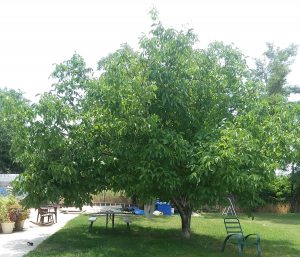
 There’s a tree in our back yard that is growing faster on one side than on the other. The other morning my daughter gave me her impression as to why this tree is so lopsided.
First, you need to know that it wasn’t lopsided two years ago when we moved into our new home. You also need to know that it was a very sad looking black walnut tree. The leaves weren’t thick and deep green. There were very few nuts that first year and not many more the second. However, this year the tree is loaded with nuts, the leaves are thick and deep green and it’s growing towards my patio.
Jodie said that she thinks it’s because the tree is reaching for our patio as if it wants to come right inside. She said that’s because it feels the love, the caring. Isn’t that an extraordinary thought!
I’m not one to talk to plants, but I love nature, outdoors, and gardening. I even love weeding. As soon as 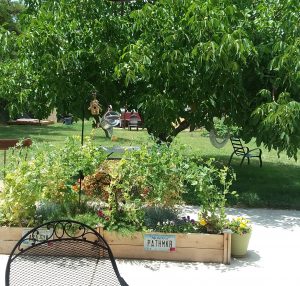 we could I built garden boxes for my patio and I’ve tended them with loving care. I feed them and I prune them. I deadhead the flowers every day, so they’ll keep blooming. I water. I am consistent.
Our patio is a shaded, blooming wildness that is irresistible. Yes, those are sweet pea plants in the flower beds, and we’ve enjoyed snacking from them for weeks.
It doesn’t really matter whether this thought about why the tree has become lopsided is true or not. It illustrates a very important, in fact crucial, fact about people, about families. We all lean into love. We want to be loved. We want to matter.
What I know from working with hundreds of families is that most parents want their children to know they matter. Why then do we unknowingly send messages that make our kids feel they’re in the way, that they’re bothering us, or that they aren’t as interesting as whatever else we’re doing, or that they aren’t good enough. It’s because we aren’t focused on being Present with our children. We check out.
It’s easy to check out in this busy world and often we don’t even realize that we have checked out. When we’ve checked out or are totally involved in what comes next on our list, it’s easy to be irritated and frustrated with our children, which leads to poor responses on our part. Children and youth don’t hear “I’m busy. I’ll help you later.” They don’t sense you’re overwhelmed or tired. They aren’t old enough or experienced enough to give you the benefit of the doubt. They hear, “You have no value.” “You don’t matter.” “This is more important than you.”
HOW TO SEND THE I LOVE YOU MESSAGE CONSISTENTLY
Here are some behaviors that we, as adults, can practice that will help us send a clear message to our children and youth that we love them, that they matter, regardless of whether they’re meeting our expectations or not, regardless of how busy we may be?
• STOP whatever you are doing. Turn away from the TV or your computer. Put down the cell phone. Saying “I’ll talk to you later” will not cut it. Say “I can’t talk right now but I will come and find you in ten minutes.”
• LOOK your child in the eye. When we take the opportunity to look another person in the eye, we send the message that we are present with them, want to hear them and find whatever they have to say important. This is especially important when we need to disciple or teach.
• TOUCH them on the shoulder, hand, back, etc. Touch sends the message that we like being with them even if we are upset with them. It connects us to them.
• RESPOND to what your child is feeling, not only what they’re saying. Are they feeling angry, disappointed, attacked, judged, sad? Focus on the feelings.
• LISTEN with patience and interest. Whatever you’re feeling, your child will know! They’re like energy magnets. If your energy is inwardly impatient, they’ll know. If you’re dying to get back to your stuff, they’ll feel it. If you’re bored out of your mind, it’s coming across loud and clear. It may all be on a subconscious level, but they know. Hold thoughts in your mind that will help you maintain interest and patience.
• ACTIVELY LISTEN – Don’t check out looking for solutions or what you want to say next. Stay Present. Hear your child and respond to what they’re saying. If you feel the need to teach don’t. Wait until later. You can always teach but your children will not always come to you if they can’t trust that you hear them.
• CHOOSE YOUR WORDS WISELY – We must begin taking full responsibility for the words we say. If we want better outcomes, we need to watch our words. Say what you want, not what you don’t want. Words generate emotions. You’ll feel the way you speak. How you feel moves you to an action that gives you a result, either good or bad.
We want our children to lean into our family, to want to be home, to see our example, and to know that they matter, that they are loved. Children who feel loved have far better outcomes in life.
This leads to the final behavior:
• BE CONSISTENT – You won’t be perfect. You can’t be. But be as consistent in your efforts as possible. If you do, it will be enough, and your kids will know that they are loved and that they matter.

 Some years ago, we had a dirt pile in the corner of our yard. Then my daughter decided to create something beautiful in that space.
 Change can be hard. One reason that change is so challenging is that we misunderstand what change actually looks like and we also misunderstand the time that is required for change.

 Every parent is made up of a measure of good,

 I got a fabulous call recently from a dear friend. She wanted to tell me about her three grandchildren, twins, aged 8 and one, aged 5. They have been playing a game with their grandma when she takes them to school 3 times a week. It’s called, Embellish the Story. One of them begins the story and then they each take a turn adding to it. In other words, they embellish it.

 I love to write but don’t always want to prepare and post a new article every week. I enjoy posting something of value every day on Facebook but sometimes I would rather do other things. However, I do both as perfectly as I can because I have a goal and to reach it, I have learned that there must be consistency in my effort, for as long as it takes.
 important in parenting because it nearly always takes until a child leaves home and creates their own life to see the results of our efforts. While they’re growing, it’s tempting to let ourselves feel failure because we don’t see our child as neat, quiet, mannerly and so forth. We often see a mud-covered child, a snitched cookie behind a back, spilled milk on the kitchen floor, or we hear voices’ complaining that it’s not their fault or “it’s my turn.”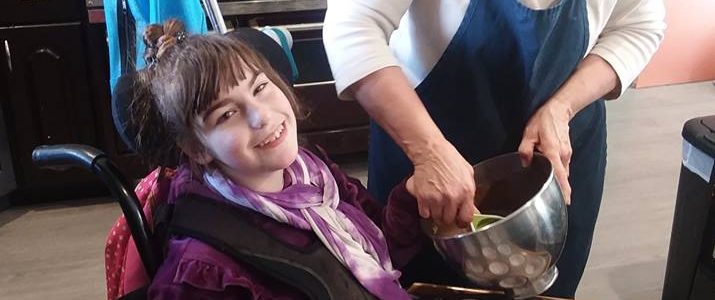
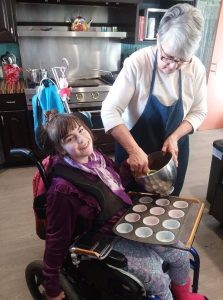 Recently, I posted a photo on Facebook of my twelve-year-old granddaughter making cupcakes. She has cerebral palsy and so it requires some special accommodation to cook with her. We’ve been cooking together now, for many years.
 3-18-2010
 and the chair on the table. Jack, of course, took his position on one of the kitchen chairs.
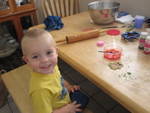 Next came the eggs. I showed Jack and Maggie how to break one and get the contents out. Woohoo!! Whacking eggs suited Jack just fine. He gave it a whack and voila! egg all over the table. Not to worry. We just picked out the eggshells and scraped the egg into the bowl. Good thing we started with a clean table.
 I could help 25-30 kids by myself. But I’m going to be honest here. It went so smoothly because the project was about me and not about the children.