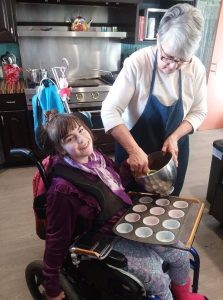
Recently, I posted a photo on Facebook of my twelve-year-old granddaughter making cupcakes. She has cerebral palsy and so it requires some special accommodation to cook with her. We’ve been cooking together now, for many years.
It’s also coming up on April 2, which is my oldest daughter’s birthday. That recalled to my mind a memory which I wrote about and want to share because the message is timeless and priceless as it applies to creating a relationship with our children and in allowing us to enjoy working and playing with them. Enjoy!
 3-18-2010
Three of my grandchildren live just a couple of blocks away. Maggie is almost four and Jack just turned two. Mary is brand new. Maggie has cerebral palsy. Working her arms and legs is a real challenge. These children belong to my oldest daughter, Jodie. Today is her birthday. I had planned to make her a cake and then decided to have Jack and Maggie help me.
My intention was to allow them to experience new things, really help make a cake, and have a lot of fun. I knew that there would be a huge mess, something unexpected might happen and I would be worn out when we were through. That knowledge has come from working with hundreds of children, of all ages.
Because of Maggie’s condition she has a special chair. It isn’t high enough to reach the table, so I put her  and the chair on the table. Jack, of course, took his position on one of the kitchen chairs.
I opened the cake mix and allowed each one to pour half of the contents into the bowl. Some made its way to the table top and some to the floor. Next, I filled three measuring cups with liquid, 1 cup water, ¼ cup water, and 1/3 cup water. I helped Maggie get hold of the large cup and pour it into the bowl.
Because this isn’t the first time that I’ve cooked with them I wanted to see if Jack could pour the cup himself so I said, “Pour it in Jack.” He took hold of the 1/3 cup and gently tipped it to one side, onto the table. Ok…he still needs help. So, we tried again with my help.
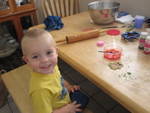 Next came the eggs. I showed Jack and Maggie how to break one and get the contents out. Woohoo!! Whacking eggs suited Jack just fine. He gave it a whack and voila! egg all over the table. Not to worry. We just picked out the eggshells and scraped the egg into the bowl. Good thing we started with a clean table.
Next, I helped Maggie get hold of her egg and smack it against the cup edge. That was necessary to make it pliable enough for her to squeeze out the contents, and squeeze she did. Some was dripping down the front of her shirt, there was a small stream running down her knee and the rest was oozing out her fingers. We did get all the egg out of the shell, the shell pried out of her little fist and hands wiped clean. Whew!
My sister had come to visit just as we began and was observing what we were doing. As I got a cloth to wipe up the egg mess, Maggie, who was just desperate to “do it herself”, reached down and plunged her arm into the batter. I turned around at that same moment. It was perfect. I took hold of the bowl and said, “Stir Maggie, stir.” She really had a tremendous time stirring that batter. It’s very difficult for her to hold a spoon and when she does, I have to help her. For a 4-year-old that’s so lame. But stirring on your own, now that’s living! I would never have come up with the solution she found. I glad my sister was there because she was able to video that small moment of magnificent success and joy for Maggie. You can see Maggie stir the cake here.
Of course, being unable to control her limbs, her hand and arm went in and out of the batter a couple of times, so we had cake mix on her, Jack and the table. Not to worry, there was enough left to bake!
I put the bowl on the mixer and turned it to stir. Watching them learn to cook was fun. Each time I accelerated the mixer the change in sound would make Maggie jump. She’s very sensitive to sound. I would pat her knee and say, “It’s OK Maggie.” After a few times, Jack reached over, patted her little knee with his smaller hand, and said, “It’s loud.”
Soon the cake was in the oven, all hands were wiped, and the table cleaned. Then I put on Winnie the Pooh and made the frosting myself.
When the cakes were cooled, I invited the kids back in and we got to work. Maggie, like any 4-year-old, wanted to lick the beater. I gave her the rubber spatula instead. She held it in place on her knee, bent her head down low (ah, the flexibility of children) and got busy. For the next half hour, we didn’t see her face once, but we heard lots of smacks and slurps. She cleaned that spatula.
While I was frosting the cake and Maggie was smacking her lips on the spatula, Jack was sucking frosting out of the decorating bag. It was a grand sight, grandma letting her little friends experience new and enjoyable things. There was no nagging about being neat, quiet or being patient. We just did our thing however it happened to happen.
The cake turned out great and I suspect, despite the fact that it didn’t get its full measure of egg, it will taste just fine. On the way home, Jack almost fell asleep. He was totally worn out from a fabulous day at grandma’s house. Maggie cried because she knew we were going home, and it’s so much fun at grandmas!
I shared this cake baking experience with you because there are some important things that I want to point out that will help many of you.
1. When you work with children, no matter the age, your intent, and your expectation really do matter.
This experience with my grandchildren would have been very different if I had worried about keeping my kitchen clean or making sure that everything was in order and done a certain way or trying to keep clothing clean. It wouldn’t have been as much fun if I had said, “Don’t be so messy”, “Don’t spill”, or “Look at your clothes”. You know what I mean. We all do it. That’s because our expectation is that it will be a well-run project, go smoothly, and the end product will be perfect.
2. As we begin to feel the tiredness that comes from working on a project with children, we can begin to feel impatient, frustrated, and possibly, even angry. That’s because we expected to have this perfect time with our kids and it wasn’t perfect, at least not in our eyes.
But let’s think about that. When we work with children whose eyes matter, whose interpretation of what should happen matters. I’ve learned that for most children it isn’t the result that they care about, it’s the process. They like doing. They like experimenting. Sometimes things don’t turn out, cookies are crumbly, plaster of paris is runny, paint is too thick, etc. It doesn’t matter to kids.
3. Is the project, chores or activity about me or the kids? For decades I would go to my children’s school and help children make gingerbread houses. I was VERY well organized, so it was a smooth project.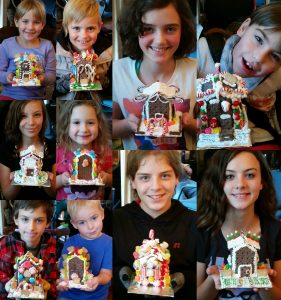 I could help 25-30 kids by myself. But I’m going to be honest here. It went so smoothly because the project was about me and not about the children.
When I first started it mattered to me how the houses looked when they were done. I knew they were going home, and I wanted those parents to be amazed, to see what a great teacher I was. So, when the kids were doing their thing I would go around and make sure that the entire milk carton was covered and that candies were evenly spread on the house. In short, I meddled with everyone’s creation.
As I got older and wiser, I stopped doing that. I made it about the children! I learned that kids don’t always care if the milk carton shows. Sometimes all the candy will be on one side of the roof and nowhere else. I learned that not everyone wants icicles that look like icicles. Some kids would rather do it themselves even if they are just bumps on the side of the house. And you know what; I’ve never talked to a parent yet who didn’t think their child’s house was great, no matter what it looked like.
I suspect that is true for a lot of you if you’re honest. It’s your expectations you think about. It’s your outcome that matters. It isn’t about just being with your kids and letting them learn and enjoy. Be honest.
4. When we’re honest we will approach projects and activities with a different set of expectations and a very different intent.
5. If being Present with our children is our ultimate goal, whether we’re playing, doing chores, homework, or any other activity, we will have a better result.
6. When we’re Present we’re better able to remember this huge difference in adults and children: adults are project driven and kids are process driven.
As we adjust our expectations to include these differences it will increase our enjoyment in working, playing and being with our children.
Your shares are the best compliment! : )


 Some years ago, we had a dirt pile in the corner of our yard. Then my daughter decided to create something beautiful in that space.
 Change can be hard. One reason that change is so challenging is that we misunderstand what change actually looks like and we also misunderstand the time that is required for change.

 Every parent is made up of a measure of good,

 I got a fabulous call recently from a dear friend. She wanted to tell me about her three grandchildren, twins, aged 8 and one, aged 5. They have been playing a game with their grandma when she takes them to school 3 times a week. It’s called, Embellish the Story. One of them begins the story and then they each take a turn adding to it. In other words, they embellish it.

 I love to write, but I don’t always want to prepare and post a new article every week. I enjoy posting something of value every day on Facebook, but sometimes I would rather do other things. However, I do both as perfectly as I can because I have a goal, and to reach it, I have learned that there must be consistency in my effort, for as long as it takes.
 important in parenting because it nearly always takes until a child leaves home and creates their own life to see the results of our efforts. While they’re growing, it’s tempting to let ourselves feel failure because we don’t see our child as neat, quiet, mannerly, and so forth. We often see a mud-covered child, a snitched cookie behind a back, spilled milk on the kitchen floor, or we hear voices complaining that it’s not their fault or “it’s my turn.”




 I bet you clicked this email because the subject line ticked you off! Twenty years ago, it would have ticked me off too. However, I hope to move you in the direction of accepting this as true because it has great bearing on what