 The POWER of Play
Parents and children’s brains don’t work the same. That statement won’t surprise any parent. Here is a story you will all relate to. Ted, aged two, hits Sally, age nine months. Sally begins to cry. You hear Sally and come running because lately, Ted has been hitting her more often. Hitting his sister is not ok, and you feel angry. You grab Ted by the shoulders, sit him in a chair, and for the 50th time yell at him that it’s not ok to hit his sister. Then, of course, Ted begins to cry.
In your mind, it’s evident that your grabbing and yelling are connected to Ted hitting his sister. You are wondering why Ted isn’t learning the lesson. You are angry and want this behavior to stop. That’s the message you intend to send. It might not be the best method, but it’s a reasonable message.
This is how Ted’s brain works, “Mommy’s angry, so she yells and hurts me.” Despite your well-intended message, the message Ted’s brain gets is that we yell and strike out when we’re angry. Unfortunately, there’s no connection between your yelling and the hitting of Sally, although, in your mind, it should be obvious.
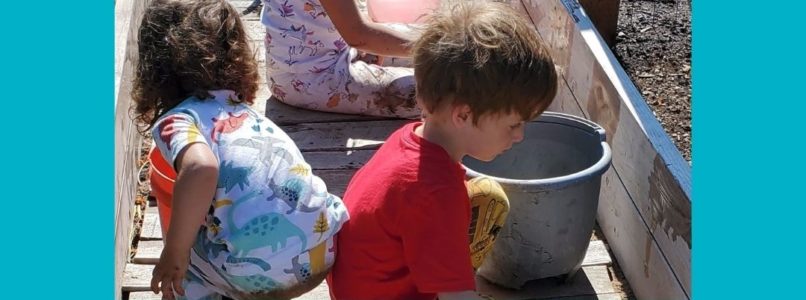
My point with this example is not to discuss discipline issues but to show that children’s minds don’t process or see the same as our adult minds do. This is especially true in the arena of learning. Children and adult brains see or process learning differently. Children learn through play, which may look to adults like pointless, directionless, frivolous time-wasting.
“Many scientists believe play is hard-wired; a central part of neurological growth and development — one important way that children build complex, skilled, responsive, socially adept and cognitively flexible brains. NYT: Taking Play Seriously 2/17/08
Psychiatrist Stuart Brown, president of the National Institute for Play, created in 1996, said, “If you look at what produces learning and memory and well-being, play is as fundamental as any other aspect of life, including sleep and dreams.” NYT: Taking Play Seriously 2/17/08
“Parents bobble between a nostalgia-infused yearning for their children to play and fear that time spent playing is time lost to more practical pursuits. Alarming headlines about U.S. students falling behind other countries in science and math, combined with the ever-more-intense competition to get kids into college, make parents rush to sign up their children for piano lessons and test-prep courses instead of just leaving them to improvise on their own; playtime versus résumé building.” NYT: Taking Play Seriously 2/17/08
Decades of research have shown that play is crucial to physical, intellectual, and social-emotional development at all ages. This is especially true of the purest form of play: the unstructured, self-motivated, imaginative, independent kind, where children initiate their own games and even invent their own rules.
“Play is motivated by pleasure. It is instinctive and part of the maturational process. We cannot prevent children from self-initiated play; they will engage in it whenever they can. The problem is that we have curtailed the time and opportunities for such play.” David Elkind, Ph.D., The Power of Play: Learning That Comes Naturally.
The temptation we have as adults, especially if we care about our children’s education, is to interfere with our children’s play, trying to make it more structured, directed, with meaningful outcomes—all with good intentions to enhance their learning experience. But remember, children’s brains don’t process the same as adults. Managed, directed, structured play ultimately becomes something other than play, and it’s play that our children’s brains really need.
“For most of human history, children played by roaming near or far in packs, large and small. Younger children were supervised by older children and engaged in freewheeling imaginative play. They were pirates and princesses, aristocrats, and heroes. But, while all that play might have looked a lot like time spent doing nothing much at all, it actually helped build a critical cognitive skill called executive function. Executive function has a number of elements, such as working memory and cognitive flexibility. But perhaps the most important is self-regulation— the ability for kids to control their emotions and behavior, resist impulses, and exert self-control and discipline. Executive function — and its self-regulation element — is important.
“Poor executive function is associated with high dropout rates, drug use, and crime. In fact, good executive function is a better predictor of success in school than a child’s IQ. Unfortunately, play has changed dramatically during the past half-century, and according to many psychological researchers, the play that kids engage in today does not help them build executive function skills. Kids spend more time in front of televisions and video games. When they aren’t in front of a screen, they often spend their time in leagues and lessons — activities parents invest in because they believe that they will help their children to excel and achieve. And while it’s true that leagues and lessons are helpful to children in many ways, (researcher Deborah Leong says), they have one unfortunate drawback…when kids are in leagues and lessons, they are usually being regulated by adults. That means they are not able to practice regulating themselves. As a result, (Leong says,) kids aren’t developing the self-regulation skills that they used to.” Creative Play Makes for Kids in Control by Alix Spiegel
Please do not misunderstand me. I am NOT saying that we should allow our children to run feral, although more feral activities would probably do our children some good. I am also NOT saying that we don’t have a role in bringing some direction and structure to our children’s activities. Instead, I AM saying that we would do well, or more accurately, our children would do better if we resisted the temptation to manage their play, trying to make it more meaningful and directed so that we could feel better about their learning outcomes.
I hope you begin to have a mental shift about what’s happening in your children’s brains as they engage in play. Rather than feeling desperate or discouraged about their play and seeming lack of interest in academics, walk with your children as their brains and learning naturally develop and mature. As you walk hand in hand together, prepare appropriately to open doors along the way and do the work necessary to effectively invite and inspire your children to walk through. And by the way, it’s fine if they don’t. The door isn’t closed forever.
One other thing. A BIG distraction to play is technology. I mentioned it briefly above, but I want to repeat it. Kids will stay on screens for hours if we let them. The older they get, the less we can manage their screen time. But your younger children will do better if you have screen-free times during each day.
Here are possibilities to consider:
- No phones at mealtime
- No screens 30 minutes before bed
- No screens for one hour after school time
- No screens before school time
- For young children, have set screen time, an hour or two a day
This Friday there was no school. My grands were on their screens the minute they woke up. But as the morning wore on, a friend came over, and the screens were discarded for spray bottles and an ensuing water fight. There was a bunch of laughing, running, noise, and commotion. It was fantastic to hear.
If we manage screen time, even if our kids say they are bored, they will find a way to play if we don’t bail them out. Give them time and ignore the pleas of “I’m bored.”
A reminder of why we want our kids to play and the long term value of strong executive function:
- They will have a good working memory
- They will have stronger cognitive flexibility
- They will be able to control their emotions better
- They will manage their behavior well
- They will have better impulse control. Ever known any adults without this skill?
- They will exert more self-control
- They will have stronger self-discipline
- A more well-developed sense of well-being
- More sustained success in school
These skills help children grow into adults who manage well in the world. So, let’s make sure there is time and opportunity for unregulated and imaginative play.



 Inspired to What End?
 Gratitude is a choice not based on what is happening to us, what we have or don’t have, but on how we choose to see what is happening to us. Regardless of our circumstances, we all have much to be grateful for if we pause and contemplate our blessings.
 Some years ago, I decided to find out what I could do to improve my life the most.
 Today I want to tell you about my brother Boe Dean, his life, struggles, and the hard lesson I learned on the day he died, January 22, 2021.

 Two years ago was my 50th high school reunion. I didn’t go. Our family was moving into a new home. The reunion was in Greeley, Colorado, a whole different state. I only went to Greeley West High School for my senior year, and I never really connected. I had friends and was involved on the school radio, worked on the yearbook, did a couple of plays, etc. I was involved but hovered in the background. Just my face in the yearbook.
 “A 92-year-old, petite, well-poised and proud man, who is fully dressed each morning by eight o’clock, with his hair fashionably combed and shaved perfectly, even though he is legally blind, moved to a nursing home today. His wife of 70 years recently passed away, making the move necessary. After many hours of waiting patiently in the lobby of the nursing home, he smiled sweetly when told his room was ready.