
Perspective is an amazing thing.
It is, simply put, the story we tell ourselves. It all begins with a thought. Once we have a thought, if we hold it in our minds, it becomes a story because our brain does its job and goes to the files and finds evidence that our thought is correct. This process takes fractions of seconds.
Once we have our story, feelings are generated. These feelings move us to an action or response. Our response produces a result, either good or bad. This little scenario repeats itself hundreds of times each day.
You’ve all heard this old saying or something like it, “What you say is what you get.” It’s true. If you say, “My kids are driving me nuts,” they’ll drive you nuts. If you say, “I can’t stand my kids today,” or “My kids are so sloppy, messy, noisy, naughty, and so on,” that’s what you’ll get. It’s what you perceive is happening, regardless of what’s actually going on. This will influence your response and your ability to be Present.
Think of all the phrases we say and hear over and over again about kids:
• You’re driving me crazy.
• You’re so messy.
• You’re so noisy.
• I can’t get a minute’s peace.
• Why can’t you listen to me? You never listen!
• You’re so irresponsible.
• I don’t know what I’m going to do with you!
• You make me so mad.
• You’re so sloppy, disobedient, messy, argumentative, quarrelsome, and so on.
• You’re wearing me out.
• I can’t listen one more minute.
If we want better outcomes, we need to watch our words. Say what you want, not what you don’t want. Words are your thoughts/stories put into concrete form. Words generate emotions. You’ll feel the way you speak. How you feel moves you to an action that gives you a result, either good or bad. Your words move you closer to or away from the ability to be Present.
Let me give you an example.
I worked with a self-employed mother who was telling herself a negative story about her son’s actions. When she needed to work, he would come into the office and ask her a ton of questions about what she was doing, how things worked, etc. It was very disruptive.
She felt he was whiney and needy. He was a bother when she was trying to work. Her responses to her son were causing a strained relationship between them. She was having difficulty figuring out how to fix the situation.
Here’s what happened when she began telling herself a more positive story. When I asked her to tell me more about her son, she replied that he was bright, loving, and responsible. So, she decided to remind herself of these qualities each time she began to experience annoyance or frustration.
When I talked with her next, I asked her how it was going. She replied she and her son were no longer at odds. She enjoyed his company. She could see that he was just interested in what she was doing, and they had had opportunities to connect on and off during the day. She was able to respond positively to him more often. She was able to be Present more frequently.
Taking control of our stories, responses and hence our results take work and practice.
Here a few simple steps to get you going.
TIP 1—Take responsibility and stop blaming
Blame is always an indicator there’s a problem with our way of being or how we perceive what’s happening, or in other words, the story we’re telling ourselves.
TIP 2—Decide to think the best of others, even your kids.
When we decide to think the best of others, we can manage our thoughts and the resulting stories more effectively.
TIP 3—Choose words wisely. Watch the words you use when thinking or speaking:
• Childlike vs. naughty
• Young vs. clumsy
• Needs more direction vs. oppositional
• Tired vs. grumpy
• Preoccupied vs. lazy
• Angry vs. rebellious
• Being a kid vs. messy
• Wants my presence vs. needy
• Has a need vs. pushing my buttons
TIP 4—Keep practicing
Keep working at controlling your thoughts. This is something you need to do daily. There isn’t a point when you’re so good at it that you can stop working on it. Negative thoughts will come, and they’ll need to be managed. No matter what’s troubling you, change is possible, and taking control of your thoughts/stories is a great place to start.
Take responsibility. You’re in control of the stories you tell. Knowing this gives you all the power.
 The idea that we should be careful to keep our priorities right in terms of not letting lesser concerns get in the way of greater ones so that we find ourselves “in the thick of thin things,” is good advice.
 I bet you clicked this email because the subject line ticked you off! Twenty years ago, it would have ticked me off too. However, I hope to move you in the direction of accepting this as true because it has great bearing on what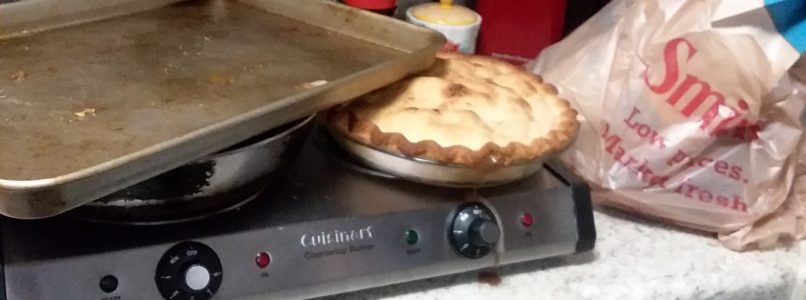
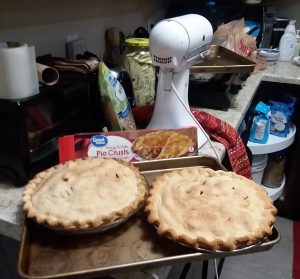 her she said that she was having tons of visits and treats but that her family could use some nurturing. Hence one apple pie.
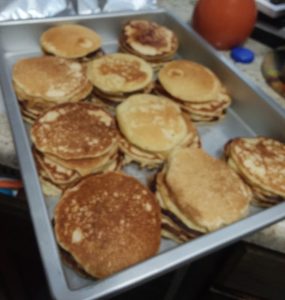 Saturday morning our church planned a Christmas breakfast. That’s right, breakfast. I would have opted to take a breakfast casserole, but my husband has a family tradition of Green Chili Pancakes and it’s so unique that he really wanted to share
  it. The problem is, he doesn’t know how to make it, I do. His grannie taught me. : ) So I needed to make 50 pancakes and then a huge pot of the green chili sauce. It was too much to do Saturday morning, so it had to be done on Friday. This is very delicious by the way.
  Long story. And I also realized that I needed a formatted document to include with a special framed family genealogy chart we are sending to our children. We are direct descendants of William Brewster of the Mayflower and I wanted to help each family understand who he was, what his family was like, and why they came to America.
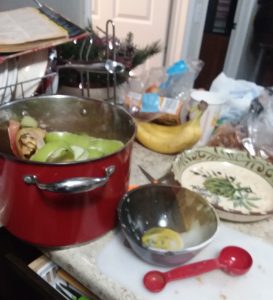 It’s Saturday morning now. The church breakfast is done. The chili pancakes were a success. Everyone loved the pies which have been eaten and I am heading off to do the tent kit and get the rest of the stuff wrapped and shipped. My house is a disaster and the kitchen cabinets can’t even be seen. I haven’t vacuumed, dusted, or cleaned anything. Laundry is piling up but I did get one load in before the breakfast. Another big woohoo!


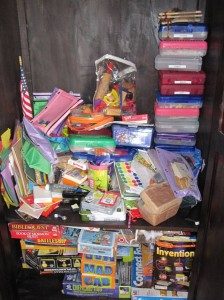

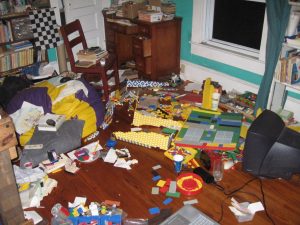 Each item we own requires some of our energy. The more belongings we have, the more emotional energy, as well as physical energy, is needed to maintain it. I want you to visualize something.
 A Very Bright Chicken!
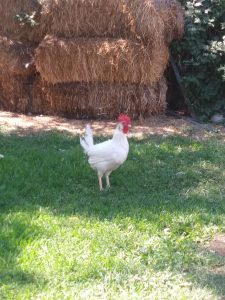 We have chickens, free-range chickens. That means they are never locked in the coop. That has its advantages and disadvantages!
 she gets in I watched her. Within minutes I saw her scoot under the fence at the corner where it connects to our neighbor’s fence. I shooed her back out. Then I placed a large rock in front of the low spot.
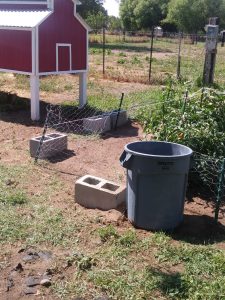 After I blocked her newest entrance I watched her pace from one end of the garden to the other looking for a way in. I could feel her frustration as she paced back and forth trying this and that.
 she went back to pacing the fence line, then she veered to the left towards the pasture fence. The fence at the back of the garden is also the fence to the back pasture. It’s made of far different wire than our chicken wire garden fence.
 Being a mother of seven busy children was a BIG job. One of the difficulties I ran into was managing all the mess and work that comes with a family. Believe me, you don’t have to have seven kids to figure out that a family takes work.