

 It’s spring — that season of newness, freshness, and quiet beginnings. It seemed the perfect time to share a story from Jaroldeen Asplund Edwards’ book The Daffodil Principle, because it beautifully illustrates something I’ve come to believe deeply: that lasting change happens 1% at a time. Not in grand gestures or overnight transformations, but in small, consistent efforts that grow into something magnificent. The story below is a beautiful illustration of this life-changing principle
Daffodil Garden
Several times, my daughter had telephoned to say, “Mother, you must come and see the daffodils before they are over.” “I will come next Tuesday,” I promised…
We parked in a small parking lot adjoining a little stone church. On the far side of the church, I saw a pine-needle-covered path, with towering evergreens and manzanita bushes and an inconspicuous, lettered sign “Daffodil Garden.”
We each took a child’s hand, and I followed Carolyn down the path…Then we turned a corner…, and I looked up and gasped. Before me lay the most glorious sight, unexpectedly and completely splendid. It looked as though someone had taken a great vat of gold and poured it down over the mountain peak and slopes, where it had run into every crevice and over every rise. The flowers were planted in majestic, swirling patterns, great ribbons, and swaths of deep orange, white, lemon yellow, salmon pink, saffron, and butter yellow.
“But who has done this?” I asked Carolyn. I was overflowing with gratitude that she brought me…This was a once-in-a-lifetime experience.
“It’s just one woman,” Carolyn answered. “She lives on the property. That’s her home.” Carolyn pointed to a well-kept A-frame house that looked small and modest in the midst of all that glory.
We walked up to the house, my mind buzzing with questions. On the patio, we saw a poster. “Answers to the Questions I Know You Are Asking” was the headline. The first answer was a simple one. “50,000 bulbs,” it read. The second answer was, “One at a time, by one woman, two hands, two feet, and very little brain.” The third answer was, “Began in 1958.”
There it was, the Daffodil Principle. For me, that moment was a life-changing experience. I thought of this woman whom I had never met, who, more than thirty-five years before, had begun – one bulb at a time – to bring her vision of beauty and joy to an obscure mountain top. One bulb at a time. There was no other way to do it. No shortcuts – simply loving the slow process of planting. Loving the work as it unfolded. Loving an achievement that grew so slowly and that bloomed for only three weeks of each year.
Still, just planting one bulb at a time, year after year, had changed the world. She had created something of ineffable magnificence, beauty, and inspiration. The principle her daffodil garden taught is one of the greatest principles of celebration: learning to move toward our goals and desires one step at a time – often just one baby-step at a time – learning to love the doing, learning to use the accumulation of time.
When we multiply tiny pieces of time with small increments of daily effort, we too will find we can accomplish magnificent things. We can change the world.
The thought of it filled my mind. I was suddenly overwhelmed with the implications of what I had seen. “It makes me sad in a way,” I admitted to Carolyn. “What might I have accomplished if I had thought of a wonderful goal thirty-five years ago and had worked away at it ‘one bulb at a time’ through all those years? Just think what I might have been able to achieve!”
My wise daughter put the car into gear and summed up the message of the day in her direct way. “Start tomorrow,” she said with the same knowing smile she had worn for most of the morning. Oh, profound wisdom!
What I Have Learned
In my 76 years, I’ve never seen anything truly great happen in a single burst. Every worthy goal, every beautiful thing built — a family raised, a skill developed, a grief endured — was accomplished through small steps, taken one at a time, for as long as it took. That is the 1% Principle, and it has become one of the truest guides of my life.
Here’s what it means in practice: rather than trying to fix or change everything at once, you focus on the best 1% — the one thing most worth improving right now. What I’ve found is that real progress in that one area quietly lifts everything else around it. You don’t have to splinter your attention across every problem. Consistent, focused effort on the right 1% creates momentum that spreads.
The woman in that daffodil garden didn’t set out to create a masterpiece in a season. She just planted one bulb. Then another. For 35 years. And the mountain was transformed.






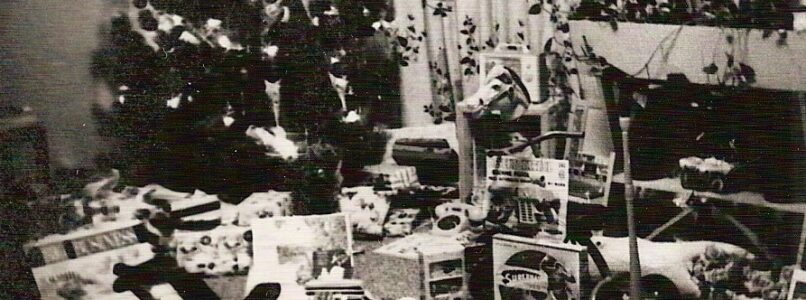
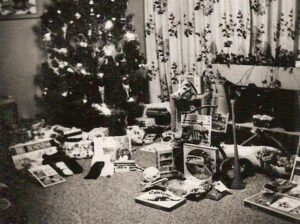 Christmas at our house was as if the windows of heaven had opened.
 Peter and the Boy


 Maggie, my granddaughter with cerebral palsy, was supposed to wear a headpiece. That was not going to work at all. She was supposed to say, “We are afraid”. She said it the best she could, as her ability to speak was minimal, and she said it with a huge smile. She couldn’t find it in herself to look afraid. Many small shepherds were wandering about, trying to figure out where they were supposed to be.
 These children were in luck. Cindy Walker smiled through the chaos. She gently called the small children back into place. She helped with lines that would never be memorized. She replaced halos, headpieces, and robes, and kept smiling. She didn’t laugh out loud at the silly things the children said and did, even though she wanted to.
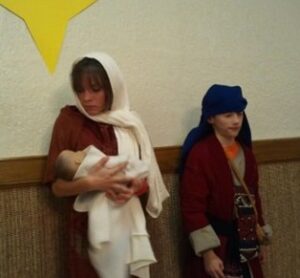 weren’t sure they liked their parts, especially saying, “I’m going to have a baby!” The soldier still felt silly. Headpieces were still falling off, belts were missing, halos still itched, no one remembered where they were supposed to stand, many parts were not memorized, and the little shepherd still smiled when saying, “We are afraid.”
 The little angel who wanted to say “Point to the star” wouldn’t leave his dad’s side and come on stage until all the other angels left the stage, and the shepherds were on their way in. Then he went and sat by the baby Jesus and made happy boy sounds with his plastic cup! (This was my grandson, Jack, age 3.) As the shepherds, wise men, and angels gathered around the baby Jesus, it was a mob, juggling each other for a space, mostly with their backs to the audience.



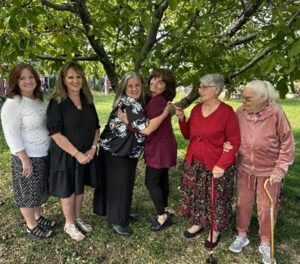

 Several years ago, I wrote an article about
 Later, I found Lizzy and Ashley sitting at the bottom of the stairs, looking at the books they brought home from the library. They had originally gone out to ride their scooters, but the books were so compelling that they never made it to the driveway. They were comparing the crystals in each other’s books, chatting away about the shapes, sizes, and colors.