 This week, as I walked with my friends Livia and Alysia, the conversation turned to their teens and the issues surrounding accomplishing things at home. At one point, Livia mentioned the need for successful systems. I told them how interesting the conversation was because I was working on my article for today, and it was about creating systems that work. Life can be so serendipitous. : )
When I began speaking and teaching, I met a woman who became a friend and mentor, Kim Flynn. She was a systems specialist and helped me and other women find time to build businesses and successfully raise a family by using simple and workable systems. At the time, Kim had owned five successful businesses while raising her family. However, long before she began business building, she was learning to use systems successfully in her home.
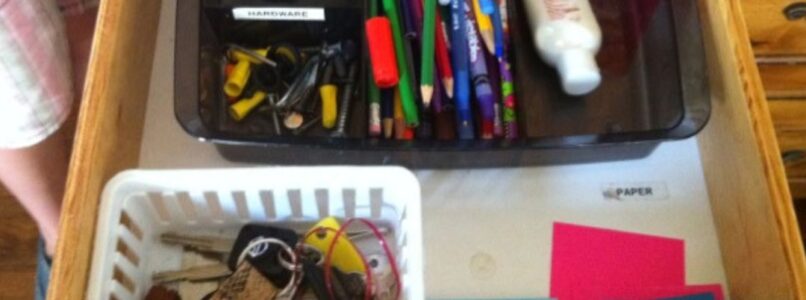
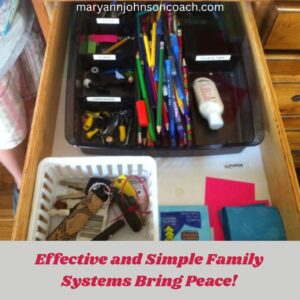
I spent plenty of time in Kim’s home and with her children. I saw firsthand how well she did the very thing she taught others to do. The drawer you are looking at was in her office. She had never reordered it since it was put together, several years before, because she had a system for its management and consistently used it. It never became a junk or catch-all drawer.
You may be thinking, “That’s all well and good, but I have kids who make chaos of everything”. When I took this photo, Kim had four children, ranging in age from 2 to 11. She included them in her systems, and they learned to respect and value the freedom that systems bring. They had learned that a good system provides more time, order, and peace in a family.
I mentored mothers on parent-child connections for over fifteen years, and this one thing came up over and over again – the need for systems that worked and a family that would use them. Recently, I’ve been thinking about the value of systems. I suspect that’s because I’ve needed a couple of new ones this year.
I use systems for everything. I am a systems guru myself. I’ve been teaching my grands about systems for the last fifteen years that we have shared the same living space. It has saved me from hunting for my scissors, tape, the milk, or butter jar (yes, they get borrowed), and many other things that would engender frustration if I had to look for them all the time.
Years ago, one of the mothers I mentored asked me how I overcame my yelling habit. I wasn’t sure how to answer her at the time, but I gave it some thought. I realized I had developed a simple system. You can’t say, “I’m never going to do such and such again” and think that’s all it takes. Willpower is never enough to bring lasting change. What I did was devise a plan, a system, if you will, for what I was going to do instead of yelling. I came up with something and began using it. It wasn’t easy. It took determination and time, lots of both.
As I thought about the process I used all those years ago, I realized that the hardest part was continuing to use the system once I had figured it out. Yes, consistency was the hardest part. Years ago, I read a piece of research that showed that often, when people find a system that works to resolve a sticky situation, they soon abandon it and return to their old, unsuccessful way of managing. Interesting!
Another problem that can mess with a good system is not enrolling your family. They have no reason to keep the system going. They think it’s for your convenience and have no vested interest. Consequently, eventually there is a mess or a missing item and you must spend extra time to reorganize or find it.
During the time spent in Kim’s home, I noticed that she not only had simple and successful systems, but she had gotten her family to enroll in the systems and, for the most part, they used them successfully. I took notes and want to share them with you.
Tips to Enroll Yourself and Your Family in Simple Systems
- Ask enrolling questions
- Ask yourself and your family to participate
- Let your family know what’s in it for them
- Then earn the right to tell, teach, or request anything of them or yourself
Example One – Overcoming Procrastination, Doing The Dishes
a. Ask yourself enrolling questions. Write your response.
- How would it feel to have a clean kitchen every morning?
- Wouldn’t it feel refreshing to never feel guilty about dishes again?
b. Welcome yourself to participate. Give yourself a pep talk. Write your simple pep talk down. You can put it by your bed to read daily or tape it over the sink. : )
- This is an exciting adventure. I’m organizing the kitchen and getting the dishes done daily. I’m having a good time watching myself grow. I’m excited!
c. Let yourself know what’s in it for you. Add it to your pep talk.
- When the dishes are done and the kitchen is clean, I am free to spend time with my family. I feel happy and energized. Starting the day without dishes is wildly freeing!
d. Earn the right to ask for this change from yourself. Add this to your pep talk.
- I have done a magnificent job organizing my Sunday School class for well over two years now. I know I can organize myself and get the dishes done, just like I do with my Sunday School class.
Once you are enrolled you will have made a firmer commitment to the change. You won’t be perfect, but you’ll be successful. Whenever you find yourself flagging in your efforts, re-enroll yourself. It helps if you read your pep talk daily till you master your new system. If a system involves your family, then see the example below for enrolling them.
Example 2 – Getting Simple Chores Done Before School.
a. Ask enrolling questions.
- Would you like to be free to rest, eat a snack, or be with a friend after school?
- Can I show you how we could do that?
b. Welcome them to participate.
- I appreciate you guys talking with me this morning. I think I have a powerful idea to share with you that you’re going to love. It is going to be so freeing and restful.
c. Let them know what’s in it for them.
- The question I have been thinking about is, how we can free up more time in the afternoon to do things we want to do. When we free up time, you’ll be able to lay on the couch and enjoy a snack without having to rush. On some days, you’ll have time to watch a video or engage with your phone. Sometimes you can even have a friend over.
E. Earn the right to make this suggestion.
- I have been your mom for over 12 years, and I know a lot about getting things done really fast to make time for rest and fun. I’ve been practicing this for a long time, and I know a lot about it.
Now lay out your plan for how the chores can get done before school time. Then make sure that the rewards happen! (This will work best if you only ask for what can be done in the available time before school. For example – make the bed, put PJs away, dirty clothes in the hamper, and toys in the closet.)
The Point of This Article Is…
To encourage you to experiment with simple systems that will work for your family, systems that you can commit to and enroll your family in. The ultimate reward for this effort is saving time, reduced frustration, living with less chaos, and having more peace. When we don’t implement systems, we live by default. Our system becomes ‘no system’. This prevents a family from functioning as effectively as it could.
Look around. What’s one thing that’s bugging you? (I said ONE thing!) How could you turn it into a simple system? Now, enroll your family in the effort to make the change. They might even have some great input as to what the system could look like.
I have systems for everything – where my glasses are kept, remembering to use my c-pap, managing the dishes, getting to bed on time, managing my mother’s clothes so she knows how to find them, making sure everyone gets the right meds, at the right time, who is in charge of what, where the tape, glue, and scissors are housed, when the laundry gets done and how, garbage management, and the list goes on!
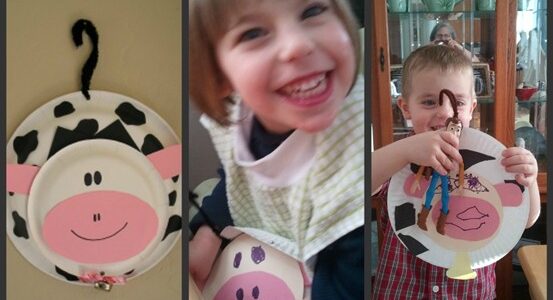
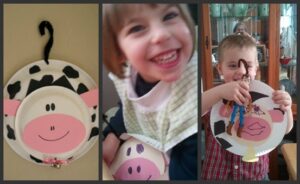 When I first began writing and publishing articles, it was in 2010. My grands, the ones I still live with, were all under five. As their grandma, I wanted to find ways to play and connect. I’m not a board game person! Tea parties and dress up are not on my list of fun things! The truth is, I like learning. I always have. I thought a lot about how I could ‘play’ with my grands and make it work for all of us. What I came up with was learning for fun. Every Tuesday, for several years, we would gather and play/learn. They looked forward to it and occasionally would tell me what they wanted to know or ask about at our next Tuesday session. It was a hit and was called Grandma School. : )
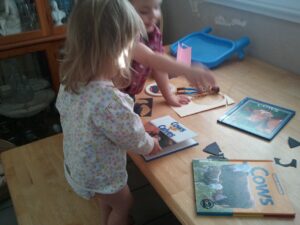 the pictures and I told them fun cow facts, such as, “Did you know a cow has four stomachs. You only have one, but a cow has four!!” That type of comment is usually followed by a question such as “Why Grandma?” Then we get to learn a bit more. Jack’s favorite cow fact was: “Daddy cows are called bulls and they go Moo really, really loud.” I did such a great daddy cow impersonation that it sent Jack into gales of laughter.
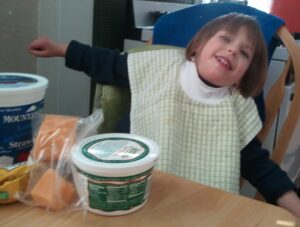 After the books, we did a cow activity. I had created a picture sheet on my computer that showed cool foods that are made from cow’s milk: cheese, cream, ice cream, milk for cereal, cottage cheese, sour cream, etc. I also had the real item on the table, if we had it. We looked at the pictures, talked about each item, and then tasted it. Of course, we all liked the cookie dough best. (It has milk in it!)
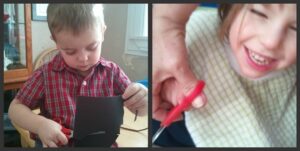 way, but then switched to using two hands and having me hold and turn the paper. Special scissors with 4 finger holes allowed me to help Maggie cut her own cow spots. She was thrilled. (Remember, Maggie, who is now eighteen, has severe cerebral palsy, so doing anything with help thrilled her and still does.)
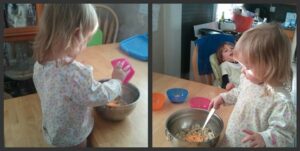 We ended the day by making mac and cheese. Cooking was a favorite activity, so everyone helped. The kids liked tasting the powdered cheese. We had our mac and cheese for lunch, and it was delicious. Maggie, Jack, and Mary decided that having cows in our world is a very good thing.
 This week, I began cleaning the top shelves that encircle my living room and the two bedrooms. It’s a big job, requires a ladder, and the accumulated dust is incredible. I only do this once a year.
 One evening, my husband Don was watching Sci-Fi on TV. I was cooking and could hear it. A man said to a woman, “To heal your wounds, you must see the past clearly.”
 where I live in our four-generation home, for over a year. It’s been nice to have his presence and help. We have all benefited, including Seth. His reason for coming here, from Montana, which he loves, was to take a series of classes to help him do some healing work. You see, no one’s past is trauma-free. It is the bag thing. : )
 I’ve written many articles on the importance of making sure the story we tell ourselves is helpful to our sense of well-being, healthy relationships, and happiness. How we perceive something matters.
 I have learned from lived experience that simple systems are usually the solution to difficult problems in time and life management. This was not an easy lesson to learn, and I occasionally still ignore this truth, but when I do,
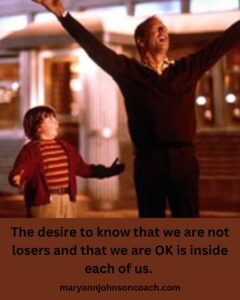 From the movie The Kid
 When I began teaching, mentoring, and writing family-centered articles, I was working with the homeschool community. However, in 2016, as I started writing my book Becoming a Present Parent, I realized my message about connecting with children was beneficial to a wider audience.
 their brain.
 brain.
 ears,
ears, very different things! When people look up towards the sky, they are looking to their Higher Power. They are looking for new answers, inspiration, and connection with whatever they believe in that is bigger than them.
 They are soul-searching. This answer may take longer to find. It also takes more trust to share. If you see your child look down, it’s essential to stop what you’re doing and adjust your focus to your child. When they find their answer, they will check in with you. If you’re not paying attention, they are not likely to share their thoughts. They will swallow them down and decide that how they feel is not important enough for your time.
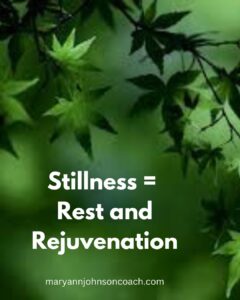 My husband was watching the show The Irrational. It’s about a behavioral science professor who solves tough police cases. I was in the kitchen and could hear it. The main character had an appendix surgery. He tried to rise from his bed a few times because there was a case he wanted to get going on. His sister had to nag at him to remain in bed and heal. At one point the professor spoke with a priest, while still in the hospital. The priest said, “St. Stillness has visited you.” Then he smiled and the professor replied, “Oh, stillness. I’m not very good at it.”
 I know that resources matter. When I was working to become a better mother there weren’t many. But what I could find, I used, and they made a difference. So, when I find a resource that may help my friends and readers, I share.