

Category: featured

The Big Epidemic

The idea that we should be careful to keep our priorities right in terms of not letting lesser concerns get in the way of greater ones so that we find ourselves “in the thick of thin things,” is good advice.


The Big Epidemic

However, getting stuck in the thick of thin things seems to be epidemic in today’s world. It can be a challenge to discern what the thin things are and sidestep them. This is a problem for every parent. There are so many things we need to do to manage our home, make a living, and frankly, get some time to ourselves. And then there are the expectations of the world; what parents are supposed to do to really give their kids a good life, to be great parents.

Let me give you two very different examples of the difficulty of staying out of thin things from two very different moms. One is middle aged and is schooling her children at home and one is older with five grown children. And just for fun, I’ll share how the issue was solved.

Phones, Screens, Frustration!

I was working with a mom who happened to be homeschooling. She really wanted to be Present with her kids during the time they were learning together but she kept getting sucked into thin things.

If the phone rang it had to be answered – it might be important. The computer and other screens were also a siren’s song. Just glancing at the screen for a few minutes couldn’t be harmful, right!

As this mom put it to me, “during our learning time are a tool of Satan!” Pretty strong words! That tells you the level of frustration this mom felt at her willingness to let the unimportant intrude on the important.

This mom, like all the parents I work with, really does want her children to know that they come first, that she loves being with them, and values her time with them. But she was struggling to not walk away from being present with her kids to take care of what was coming in from the world. It was making her feel terrible.

Wisely, she pondered the situation, did a bit of knee time and came up with a solution. She decided to turn off the screens when she wanted to be present with her kids during their learning time. She turned the computer off at night, so it wouldn’t be a temptation in the morning and then when she got down to business with her children, she put her phone on silent.

The outcome is that she’s been able to be truer to her family and herself. She can be present for small amounts of time and accomplish her goal of teaching her kids, but more importantly of sending the message that they matter to her and are at the top of her list.

Expectations, Stuff, and Guilt!

I have another friend who has raised five children. In a recent conversation, she mentioned her dismay at all the stuff that she still had from when her kids were living at home. You know the kind of stuff we save – school photos, childhood drawings, old school papers, awards, etc. She felt that somehow, she had let her kids down because they didn’t have all this stuff in beautiful scrapbooks. I mean, all her friends had made beautiful scrapbooks for their kids, she was sure of it. She felt guilty. It weighed on her mind.

This is what she said to me “I guess I was too busy helping kids with lessons, sitting through games, playing, supporting plays,” … her voice trailed off.”

When I called her on this she smiled and said, “Your right. All that stuff I did with my kids was really more important, wasn’t it?”

Seth and his treasures : )

Now there isn’t anything wrong with a beautiful scrapbook or looking at a screen if they don’t take us away from time we should be connecting with our family. I made a few scrapbooks for some of my older kids, but they didn’t have any fancy pages. I just paper punched the sheets and put them in the binders. My son, Seth, who is on the downside of forty, still has his and thinks it’s the best. He never missed beautifully crafted pages. Andrew doesn’t even have a scrapbook, he was farther down the line but he loved the box of his stuff.

And if you feel pressed about all that stuff you seem to be collecting for

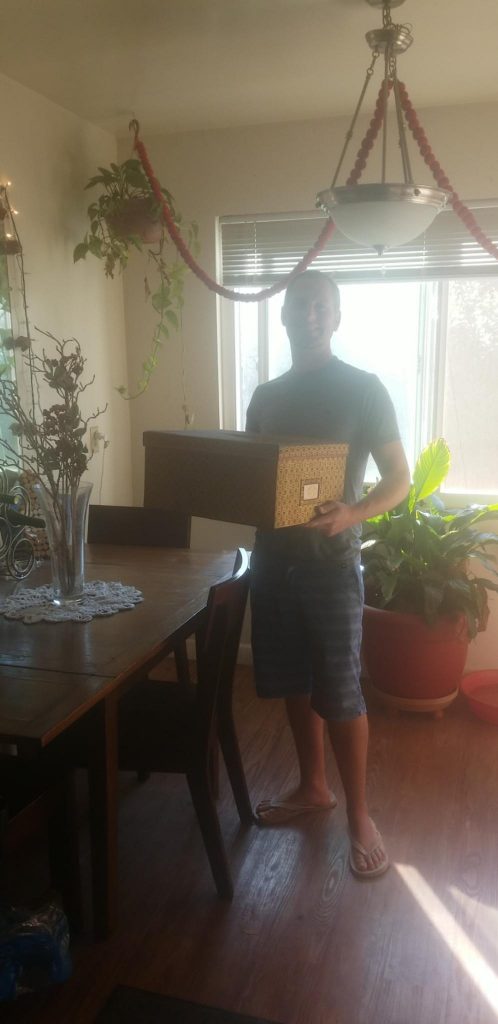
Andrew and his box of ‘stuff’.

your kids here is a thought. A couple of Christmases ago I bought some pretty storage boxes. Then I sorted all the stuff, and after seven kids there was a bunch of it! I put each child’s treasures in a separate box and that’s what Don and I gave them for Christmas.

How did that go? They LOVED them. It was so fun to watch them sorting through the contents. You could hear, “Do you remember this.” “Oh my gosh, I can’t believe I did that.” They sat and reminisced for a couple of hours. Since then they have discarded most of what I thought needed to be saved all those years ago.

Funny how we downplay the time we spend with our family, connecting with one another. We rarely give it the kudos it deserves. Funny how we sometimes elevate the value of things that matter far less.

As the world gets busier and noisier and the expectations increase, it becomes critical for us to carve out time for those things that are of greatest importance, our children, our family, our time together.

“We become so caught up in the busyness of our lives. Were we to step back, however, and take a good look at what we’re doing, we may find that we have immersed ourselves in the ‘thick of thin things?’ In other words, too often we spend most of our time taking care of the things which do not really matter much at all in the grand scheme of things, neglecting those more important causes.” (“What Have I Done for Someone Today?” Pres. Thomas S Monson, Oct. 2009)

Being present doesn’t require a lot of time. It does require letting go of outside influences and focusing on those who matter most. When we look someone in the eye and listen, we send a very clear message: I see you. I hear you. You matter to me.

Your shares are the best compliment. : ) 

I’ve Got The TONE!


Nature abhors a vacuum.


Aristotle believed this was true and so do I.

I used to rage/yell. Even though it took ten years to stop raging and many years before that to even see that raging might be a problem, I have felt very proud of the accomplishment. However, if we’re open to growth we won’t rest on past laurels.

Not too long ago I was having a conversation with my son-in-law, Kash. He’s married to my third daughter and we see their family a couple of times a year. I like Kash a lot.

He and I were talking about making changes, what that process looks like and so forth. I happened to bring up the raging thing and this was his reply, “Well, you know what I hear in your voice most of the time – frustration and annoyance.” WHAT!!!

Man, that was like having cold water thrown in my face. Whew! But I have learned over many decades to pay attention when the Universe/God speaks, even if the voice is funneled through my son-in-law. So, I spent some time pondering what he had said and, being a praying person, I spent some knee time asking God about the situation.

When You Discover a Weakness

CELEBRATE! 


Guess what? He was 100% correct. Now in my past, I would have felt terrible and castigated myself for having yet another weakness. But no more! I do not do that “beat myself up for not being perfect” thing. In fact, after catching my breath I did a halleluiah dance. Really, in my mind I celebrated.

It’s been over twenty years since I stopped raging and it had finally become time for me to make a new advancement in my life. I know this because I have been shown a current weakness that I’m prepared both mentally and emotionally to change. It’s an event to celebrate.

After I returned home, I made it a priority to see what this frustration/annoyance looked like in my daily walk. It was easy to see, now that I knew it existed. It’s a tone in my voice. It’s not the words or the feelings behind the words. What I had done over twenty years ago was replace raging with a tone.

You see, what I didn’t realize back then that I understand now is that you can’t just say, “I’m going to stop yelling/raging.” You must also decide what you’re going to do instead. You must replace one way of being with another. Remember the earth abhors a vacuum. By default, I replaced raging/yelling with a tone of voice that lets people know I’m not happy or satisfied with them or the situation.

I decided that I wanted to replace the ‘tone’ with a calm and peaceful response. I have written about taking control of our response many times and I know it’s doable! I believe that I’m 100% in control of my response no matter what is happening.

So, I’ve been paying attention. Man, this has become a deep-seated habit for me. Every day I hear the tone many times. If I didn’t know what I know I would be discouraged because on the surface I don’t seem to be getting a handle on it. However, I’m clear about what change looks like and frankly, it looks like failure long before it begins to look like or actually become success.

You may be at a place in your life where the Universe/God knows you’re mentally and emotionally ready for a change. Celebrate and decide what you will replace the current behavior with. Then get clear on what change looks like in real life. Here are the steps that I have experienced repeatedly and have watched those I mentor experience. Understanding and embracing these truths will help you stay the course while making lasting changes.

 5 Steps to Lasting Change


1. Recognize that there is a need for change or adjustment. I recall weeping on the phone during a session with one of my mentors. She asked me why I was crying, and I replied, “I am ______ years old. I should have known that!” She reminded me that we come to knowledge when we’re ready to do something about it and not until. You can read, hear or be taught something and never really internalize it. That’s because you weren’t ready. When we’re ready the teacher will come in some form. There is no need to weep over the time that it’s taken to become ready. Just celebrate that you are now ready and then go to work!

2. You will continue behaving in the old way for a time, but the difference is that you recognize that you’re doing what you don’t want to do. Because this step can last a while it can be discouraging and we are tempted to think, ”I’m never going to overcome this, or change this.” But the truth is that this is what the second step looks like so don’t get discouraged. It can and often does look and feel like failure before it looks or feels like progress.

3. Eventually, as you begin doing the very thing you have decided not to do you will catch yourself in the act and reverse course. This step can feel a bit challenging because it usually involves apologizing, some explaining and then starting again. But it’s worth it!

4. The next step is having a desire to behave, speak or act in the old way but then choosing not to. There is a space between stimulus and response and in that space, we get to choose. When we begin making a change that space is small and for some, seems non-existent, but I promise it’s there. I also promise that we can increase this space for choice.

5. Our way of being has changed. We no longer think about responding in the old way. We just respond in the way we have chosen. Our very nature has changed. We have become a new person in that one thing. We no longer must practice because “we are changed”.

Anyone can change. We just need to understand what change looks like in real life, the steps, and then be persistent and consistent.

Your shares are the best compliment. : ) 

Exploding is ALWAYS a Choice

I bet you clicked this email because the subject line ticked you off! Twenty years ago, it would have ticked me off too. However, I hope to move you in the direction of accepting this as true because it has great bearing on what we have been discussing for the last two weeks.

We have talked about how our perception of what is happening fuels our emotions and leads to a response either positive or negative. We have also looked at seven tips to help you learn to control your responses when things go wrong.  However, you have to believe that controlling your response is even possible.

How I Learned to Take Control

When I was a young mom, I was prone to exploding/raging on a regular basis. I am not proud of this fact and it took me quite a few years to come to the realization that exploding/raging was not only ineffective when dealing with my husband and children but that it was detrimental to healthy family relationships. You see I came from a family of exploders. It’s what we did, how we dealt with disappointment, sorrow, frustration, etc.

Eventually, I did begin to see that exploding/raging was counter-productive and that it never resolved whatever it was that was causing me to explode/rage in the first place. But I couldn’t see how I could ever stop this behavior because it was so immediate. I mean there would be a stimulus of some kind and then an explosion. There wasn’t even an opportunity to not explode/rage.

However, as the years went by, I began to learn more about stimulus and response and I realized that there was a moment of choice. It took me a long time to accept this because if it was true then I could choose to not explode/rage. It made me responsible for what I did and took the responsibility away from the circumstance or another person. It made me 100% in control of my response.

That was intimidating! It felt like a huge and burdensome responsibility.

One thing I learned and began to believe in fully was that there was a space between stimulus and response, no matter how small. When I had accepted this as true I was able to move to the next step: believing that I had the power to increase this space.

The first thing I did was begin to analyze what happened after each explosion. What triggered it? What was my perception of what was happening? Was I blaming anyone or anything? What was I really feeling because I knew that anger is always a secondary emotion? Was I disappointed, embarrassed, feeling disrespected, what?

Looking carefully at what caused me to explode was helpful.

It didn’t take long for me to begin to be able to see in my mind what was happening. I could see the trigger and then see the explosion and in between, I felt a tiny space for choice. I also began to see that I chose to explode. It’s hard to put this into words but I think if you’re a person who lets your response get out of control you will know what I’m talking about.

Next, I stopped beating myself up when I behaved inappropriately, and I just looked at what had happened. I gave myself credit for wanting to do better, to be better.

As I did this, I began to feel hopeful that yes, I could take control of my responses. I began to feel the space between stimulus and response get larger, I could feel myself making the decision to explode. Rather than feeling badly about this I allowed myself to celebrate that I could see myself choose. This made it possible, over time, to begin making a different choice.

Eventually, I stopped exploding/raging. I rarely do it anymore. I still see the space in most situations and I feel myself choose.

A couple of weeks ago I told you about my husband and my good sewing scissors.  What I didn’t reveal in that story was that when I picked up the scissors, I felt the space for choice and I saw myself choose to be angry. Then I marched into the house and confronted my husband. I didn’t explode/rage as in the old days, but I was clearly annoyed with him.

As I walked away from him after my harsh words, I felt myself in that space between stimulus and response and I knew that I wanted to remain angry at him. So, I came to a dead stop in the middle of my kitchen and asked myself, “What are you really feeling.”

Here it is in a nutshell. I was frustrated that the office wasn’t finished. I was feeling anxious because the weather was changing and all my office stuff was under a tarp on the patio. I was weary of controlling my anxiousness because this part of my life was out of order.

Then I did what I have practiced for years now, I chose to let go of my desire to remain angry and I smiled. Smiling releases endorphins and even if the smile isn’t genuine it changes how you feel. I was able to pull myself together, apologize to my husband and talk about what was really going on.

Exploding/raging or even being angry, no matter the underlying cause, is always a choice. You are 100% in control of how your life looks. If you feel like you have no control, I promise that when you accept this you plant your feet on the path to control. As you increase the space between stimulus and response you will find a sense of freedom and you will be happier!

Nine Steps to Increasing Your Ability to Choose

Let’s put the steps I took to increase the space between stimulus and response into order:

1. Believe that there is a space between a stimulus and your response and that no matter how small it is now it can be increased
2. Believe that it is in your power to increase your space for choice no matter how poorly you are doing at present
3. Understand that when you take 100% responsibility for your life and your responses it is not burdensome but is the most freeing thing you will ever do!
4. Once you have these beliefs planted in your mind, begin analyzing every time you respond inappropriately. What were the real reasons? What triggered it? What was your perception of what was happening? Were you blaming anyone or anything? Be honest.
5. Never berate yourself for falling back into the old behavior. I gave myself credit for wanting to do better, to be better. It’s a wonderful thing to come to know where you are in error and then taking steps to change, no matter how long it actually takes to change. Celebrate that!
6. Begin to mentally see the space between the stimulus/trigger and your response. Mentally see it enlarging. If you are a praying person I have found this to be invaluable in assisting me to see in my mind this enlarging of the space for choice.
7. Avoid discouragement. This isn’t an easy or quick process for most of us but it is doable over time. How long did it take me to stop exploding/raging? Ten Years!
8. Never quit. Keep seeing. Keep analyzing. Hold on to the belief that you can choose anger or not.
9. Remember that small and simple things done consistently over time bring the desired results.

Your shares are the best compliment.

What Can You Do When You Have a Mess?


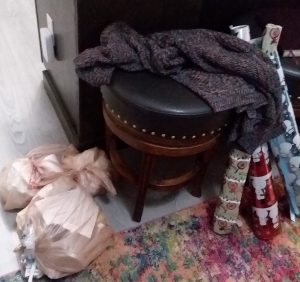
See those garbage bags-been there three days. They might get thrown outside today!

The last three weeks have been packed. I tried to get Christmas done and mailed before my trip to Seattle to help my daughter who is pregnant and very ill. But life is life and I live in a four-generation household and… well, I didn’t get it done.

Seattle was wonderful, busy, fun, and tiring all at the same time. I came home with croup. I know, only kids get croup but every few years I join them. I don’t feel ill, but I sound terrible and feel totally worn out, so Wed. and Thurs. I didn’t get much accomplished. But I couldn’t rest on Friday because there was so much to do.


Here’s what I was trying to accomplish on Friday 

  • Bake three apple pies
  • Make another tent kit
  • Go to the doctors
  • Get my mom to take a bath and trim her hair
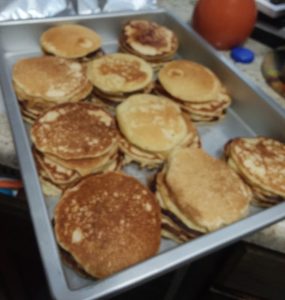
  • Make 50 pancakes and a pot of green chili
  • Create and format a special document
  • Get all the rest of Christmas wrapped and shipped

I have a friend who had surgery the day before I flew home from Seattle. When I asked how I could help her she said that she was having tons of visits and treats but that her family could use some nurturing. Hence one apple pie.
My neighbor loves apple pie too and I have had her on my gift list for three weeks. I wanted to give her a pie and if you’re going to make one pie you might as well make two right! But if I bake and give away pies, I must make one for my own household or there would be a rebellion. So, three pies.

Saturday morning our church planned a Christmas breakfast. That’s right, breakfast. I would have opted to take a breakfast casserole, but my husband has a family tradition of Green Chili Pancakes and it’s so unique that he really wanted to share it. The problem is, he doesn’t know how to make it, I do. His grannie taught me. : ) So I needed to make 50 pancakes and then a huge pot of the green chili sauce.  It was too much to do Saturday morning, so it had to be done on Friday. This is very delicious by the way.  You can print the recipe HERE.

Now all of this wouldn’t have been too bad, but we had a double doctor’s appointment in the afternoon, we had to stop at two stores on the way home to get some items we needed to finish the above projects and that whole thing took three hours.

I was still trying to get my Christmas items packed and shipped but found that I needed one more tent kit. Long story. And I also realized that I needed a formatted document to include with a special framed family genealogy chart we are sending to our children. We are direct descendants of William Brewster of the Mayflower and I wanted to help each family understand who he was, what his family was like, and why they came to America.
I was able to create and format the document but never made a dent in the gift wrapping or the tent kit making. I did get mom bathed and her hair trimmed. Big woohoo!

It’s Saturday morning now. The church breakfast is done. The chili pancakes were a success. Everyone loved the pies which have been eaten and I am heading off to do the tent kit and get the rest of the stuff wrapped and shipped. My house is a disaster and the kitchen cabinets can’t even be seen. I haven’t vacuumed, dusted, or cleaned anything. Laundry is piling up but I did get one load in before the breakfast. Another big woohoo!



Here’s my point – life can be overwhelming even when we don’t plan for it to be. Sometimes we get stretched out, tasks bunch together and it feels heavy. In those moments, in my past and younger life, I would go to bed feeling like a failure. I would wonder why I couldn’t get more done. Why wasn’t I like so and so who not only gets more done but looks great too and on and on!

Here’s what I don’t do anymore:

  • I don’t compare myself to anyone! Really everyone has their hidden disasters!
  • I don’t beat myself up because I’m not perfect, slow, behind, didn’t plan better, start sooner, stay well, look put together, etc.
  • If I find myself having a hard time managing my thoughts about myself I pray. Find something that works for you!
  • I work diligently to refrain from blaming anyone, or anything for my slowness, tiredness, lateness, etc. I don’t blame! Sometimes it is what it is.

Here’s what I do to manage those times when life is just too much:

  • I practice remaining calm and if I need to I go to the bathroom and read a few paragraphs and breathe
  • I do what I can and I let it be enough
  • I remember to do the few things that make me feel cared for (my nightly shower and reading in the bathroom)
  • I make an effort to get enough sleep even if it means not getting as much done in a day
  • I take time to remain Present – at least once a day. Being Present happens in 5-minute chunks. This takes practice, even for me
  • I pray a lot! and I force myself to smile : )

I hope that this holiday season you’ll work on being your own best friend. Say no a bit more. Compare less. Talk nicely to yourself. Remember small moments of self-care. Smile even when you don’t feel like it. Be Present at least once a day with someone you care about. It can take 5 minutes or less!

Your shares are the best compliment! : ) 

7 Tips for Controlling Your Response When Things Go Wrong

Last week I shared two stories about how our perception of what is happening fuels our response; that paying attention to our thoughts and the stories and emotions they generate is important when parenting and is a skill which can be learned and practiced.

Yeah right!! There was a time when I didn’t believe that I could control how I felt let alone that it was a skill which could be learned. Many of you may also have a difficult time accepting that you can control how you feel and respond.

CAN CONTROLLING YOUR STORY MAKE A DIFFERENCE?

I was a reasonable person, and I lived a good life but, darn it, stuff was always happening. I mean, if the kids are acting crazy, it’s going to make you feel crazy. If milk keeps getting spilled, if the house is getting trashed, and if grades are down, you feel down yourself. When money’s tight or your spouse isn’t helping you out, you feel overwhelmed. If you feel unsupported or if you have a health issue, all of this is going to mess with how you feel and respond, right?

Back then I knew the answer was a big fat yes! But time and experience have proven to me that you can control how you feel by taking control of the stories you tell yourself.

THOUGHTS CREATE OUR STORIES

Perspective is an amazing thing. It is, simply put, the story we tell ourselves: what we think is happening or has happened. It all begins with a thought. Once we have a thought, if we hold it in our minds, it becomes a story because our brain does its job and goes to the files and finds evidence that our thought is correct. This process takes fractions of seconds and this scenario repeats itself hundreds of times each day.

You change your story by controlling your thoughts. You manage your emotions by controlling your story. When you do this, you take more positive actions and you get better results. It is a skill and the more you practice it the better you get!

TIPS FOR HAVING BETTER STORIES

TIP 1—Take responsibility and stop blaming
When we choose to tell ourselves stories that blame others, we decide to become victims. Victims parent poorly. I hear parents blame their kids all the time for how they’re feeling.
• You make me so mad.
• You have ruined my day.
• I can’t think straight because you’re so noisy.
• I wouldn’t be yelling if you would listen.

Blame is always an indicator there’s a problem with our way of being or how we perceive what’s happening.

TIP 2—Decide to think the best of others
A father expected his 16-year-old daughter home at a certain time but she was late, very late! He began writing a mental story. He imagined all sorts of scenarios for why she was late. She lacked respect for family rules. She was thoughtless. She was irresponsible. The later she was, the bigger the story grew and the angrier he became. As she opened the door, he exploded with, “You’re late! You know the rules, and you broke your promise. You’re grounded, young lady.” Of course, his daughter ran to her room crying.

To let you in on the facts, the girl’s date had taken her to a drinking party after the movie. When she asked him to take her home, he refused. She had tried to call home, but the line was busy. So she called a friend who got off work at midnight and came and got her. In the meantime, she sat on the curb in the dark because the party was out of control and not safe.

The father’s story was at the heart of the problem, not his daughter’s lateness. When we decide to think the best of others, we can manage our thoughts and the resulting stories more effectively.

TIP 3—Choose words wisely
“What’s in you is what comes out.” It’s true! Pay attention to the words you say in frustration, sorrow, and anger; you’ll get a good idea of what you’re holding onto in your subconscious mind.

Our words reveal what we truly feel. The words that we allow to come out of our mouths are what ultimately drive feelings and the resultant actions and bring the results we live with daily.

Watch the words you use when thinking or speaking about your children and teens:
• Childlike vs. naughty
• Young vs. clumsy
• Needs more direction vs. oppositional
• Tired vs. grumpy
• Preoccupied vs. lazy
• Angry vs. rebellious
• Being a kid vs. messy
• Wants my presence vs. needy
• Has a need vs. is pushing my buttons

TIP 4—Check your core beliefs
We can get an idea of the beliefs we’ve formed growing up by paying attention to the stories we tell ourselves over and over again and by listening to the words coming out of our mouths. These beliefs may not be supportive or helpful in having good relationships with others or in our ability to be Present and parent well. Once we’ve found a core belief which is not helpful, we can get rid of it by rewriting the story.

TIP 5—Track your thoughts
Because thoughts are powerful, we need to gain control over them in order to stop getting more of what we don’t want. Once you’re aware of a negative thought, you need to capture it—write it down. You might be thinking it’s crazy to write down negative stuff, but I’ve lived this, and I know it works! So pay attention to your negative thoughts and write them down. Look for patterns, unsupportive and destructive stories and repeating themes. You can shred or burn your daily list periodically. Take control!

TIP 6—Teach others what you’ve learned
Teaching others what we’re learning and experiencing is a powerful tool that helps us make even greater changes. As we teach others, we clarify for ourselves. If we teach what we learn to our family, we’ll be heartened as we see them making changes also, and our whole family will be blessed.

TIP 7—Keep practicing
Keep working at controlling your thoughts. This is something you need to do daily. There isn’t a point when you’re so good at it that you can stop working on it

Would you like to know more about these seven tips on controlling your responses with your children, then check out the book Becoming a Present Parent: Connecting With Your Children in Five Minutes or Less.

Your Shares are the BEST Compliment. : ) 

When the Result Stinks You’re the Problem!

My mom, NaVon Cazier

My mother has come to live with us. She is eighty-seven and has Alzheimer’s. That makes every day an adventure.

My mother and my husband both go to bed a bit later than I do because they sleep in. Recently, early in the morning, I used my blow dryer for about a minute and a half. This is not an exaggeration as my hair is short and I do very little to it.

All of a sudden my mother appeared at the bathroom door demanding, “What in the H___ are you doing that in the middle of the night for!” Whoa, that took me back and I replied, “Well mom, it isn’t the middle of the night. It’s six forty-five and I am getting ready for work.” By this point, she was already heading back to her bedroom mumbling about the inconsideration of some people and having her sleep disturbed in the middle of the night.

My husband, Don

I have a wonderful pair of scissors. They cost a bit of money and I keep them in a drawer with my sewing supplies and I NEVER use them for anything but cutting material. Recently, I was sewing an item and left the scissors sitting on a pile of material scraps on my kitchen counter.

Later that day I found them outside, on the patio, in front of the door of our new office where my husband had been doing some electrical wiring. I knew that my husband, unable to find the pliers, had used my good scissors to cut his electrical wires! I picked them up and marched into the house, stood in front of my husband and said in a very irritated voice, “Why were my good sewing scissors outside by the office? These are expensive scissors and are only for cutting material!” Needless, to say he was taken back and replied, “I don’t know why they were outside.”

These are two really wonderful examples of how the story we tell ourselves can and does impact how we respond.

OUR RESPONSE MATTERS   

When we’re parenting children understanding the connection between what we think is happening or has happened and how we respond really matters.

It matters for two reasons:

  • What we think will determine if our response is appropriate or not
  • Our response will send a message to our child about how we feel about them and often about who they are regardless of whether this was our intention or not

Frequently, if our story is skewed, our response is harsh and inappropriate and the message it sends is damaging to how our children feel about themselves.

In the case of my mom, her story was that it was the middle of the night and so she felt that I was totally inconsiderate of the rest of the family and that fueled her angry response.

In the case of the scissors, my story was that Don was using them inappropriately and that he was an adult and should have known better and that fueled my accusatory and angry response.

In both cases we were wrong in what we perceived was happening.

My mom and I both sent a message that we didn’t really intend to send. My mom was bugged that her sleep was interrupted but she doesn’t really believe I am an inconsiderate person but if I had been an impressionable child or teen her response could have sent a negative message that could have been internalized as true.

I know my husband isn’t inconsiderate and inappropriate but my message implied that he was both. Often the message that we send to our children when we’re not in control of our response is that there is something wrong with them, not with what they may or may not have done.

Thoughts, perceptions, and beliefs create a story and based on those stories we feel an emotion and then respond. Our response generates a result which can be good or bad, helpful or unhelpful.

Paying attention to our thoughts and the stories they generate is important and is a skill which can be learned and practiced. As we do so our lives get better and happier because we have more positive outcomes for ourselves, our relationships, our children, and our family.

Next week I will share seven tips to help you begin practicing the skill of controlling your response even when you are angry, frustrated, irritated, etc.

Your shares are the best compliment.


Sixty-Eight Thanksgivings and Counting!

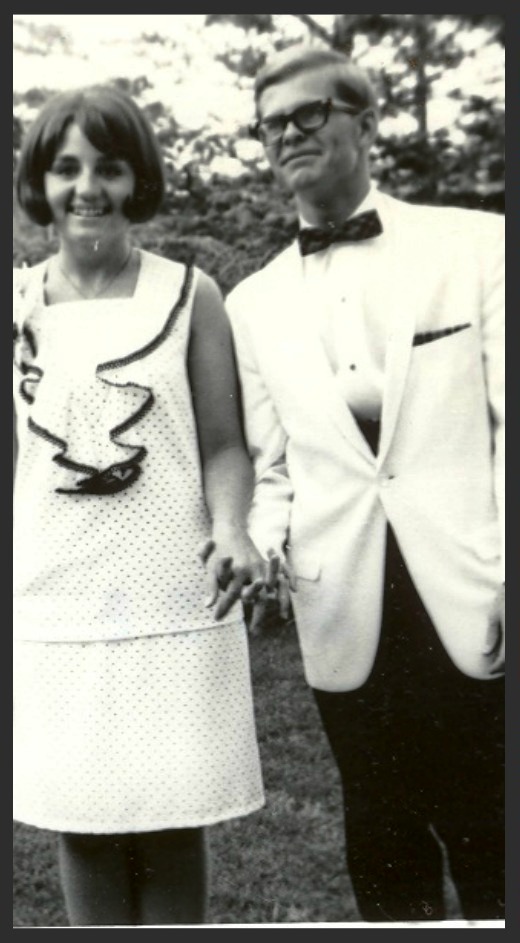
In two months I will be sixty-nine years old and my husband will be seventy. I contemplate that and I am amazed and astonished. It makes me smile with pure joy. Can you even imagine such a thing; to live this long! What an amazing thing to accomplish!

Next week is Thanksgiving. My sweet husband will be hovering around me like a moth, giving me little kisses, hugs, and small touches as I make the pies. That is a tradition

SWEET SWEET PIES

Back when we had just ourselves and our seven children we had at least 2 pumpkin, 1 cherry, 1 apple, and a lemon meringue but as we added spouses it grew to include 3 pumpkin, 2 cherry, 2 apple, the lemon meringue, a pecan, and a chocolate cream.

This year as I bake I will be thinking about past Thanksgiving days while we were raising seven children. I realize that this year is decidedly different. Past days were about family being together, having enough food, laughing and feeding pie to the neighbor kids and those brought home from college.

This year there is a new feeling. Don and I are both feeling the magnitude of what we have created in our almost seventy years.

When we married we were 21 and 22 years old; fresh, innocent, foolish, full of wonder at each other and the possibilities of life. At just shy of seventy we are no longer fresh, innocent and hopefully not as foolish, but I think we are still full of wonder at each other and the possibilities of our life together.

Can you imagine how it feels for us when we are with our family? As we look over our seven children and see wonderful, well adjusted, kind, loyal and intelligent adults it is remarkable. And now we have a bevy of spouses.

Added to our children and their spouses are thirteen grandchildren. They are all still fresh, innocent and full of the wonder at the possibilities of their lives. They are young, only three have passed eighteen.

When Don and I are in our mid-seventies, just a mere six years from now some great-grandchildren will most assuredly have been added. Can you imagine how that will feel? We are filling the world with beauty, loyalty, and kindness, it is our greatest achievement. This year we see it clearly, through older eyes and we can barely contain the joy of it all.

Family, it is the height of what we create in this world, the only truly enduring thing, that which should consume our most treasured hours. Parenting is a big job. It can feel overwhelming and can often feel as if we are failing. But there are some simple adjustments in our thinking which can help us use the time we do have with our children to better advantage so that our relationships are stronger and sweeter.


All We Have Are The Relationships

We Have Forged

As I eat Thanksgiving pie this year they will be sweeter than ever before. Despite the difficulties of raising a family, learning to parent, learning to be a good spouse, making a living and all the rest I am content and I thank Heavenly Father and Jesus Christ that I have been so richly blessed.

At the end of the day, all we have are the relationships that we have forged –healthy or unhealthy, strong or weak, good or bad. This is especially important to remember when building our family relationships. Simple things, done consistently over time, lead to amazing success in the home.

Here’s wishing you a very wonderful holiday season. And I hope you will take a bit of time to learn how to strengthen your family relationships without breaking your time bank. Get your free chapter HERE.

Your shares are the greatest compliment. : )

You Can Improve Your Parent-Child Relationships

What Is Really Important?

Here’s a true story. A father was painting the outside of his home. His five-year-old son wanted to help. So this good father gave his son an old shirt with the sleeves rolled up several times. They both went to work on the door, dad painting the top and son painting the bottom. It just happened to be the door to the main entrance.

Now because of his age and size, the young boy wasn’t able to spread the paint evenly and consequently, the paint was beading up. That certainly wasn’t how the father envisioned his front door. So each time the five-year-old bent down to get more paint the father would hastily smooth out the paint on the bottom panel. It couldn’t do any harm, the boy didn’t know what was happening and the door sure would look better.

Well, father and son painted in silence for a time, the boy doing his best and the father smoothing it out. As the father thought about the situation and his redoing of his son’s work he decided that working with his son trumped a first-class paint job. He realized that his son was doing a mighty fine job for a five-year-old. The relationship that was being forged over the painting of a door was more significant than the appearance of the door. He stopped smoothing out his son’s work.

Ever after that when the father approached the front door and saw its distinctive style of decoration he was reminded of what is really important.

The father of this five-year-old boy spoke about his experience, with his own father. His father had a workshop in which he made wonderful things. His son said, “I would wander into this workshop and watch him. Just to be in his presence was a thrill for me. He invited me to help him by passing a hammer, a screwdriver, or some other tool. I was convinced that my help was necessary and that without me he would not be able to complete his task.

As I look back and reflect upon those wonderful memories, I realize that my contribution was not necessary for my father to complete the work he was engaged in. I was the beneficiary, as through these experiences I came to know him and to love him. I came to know about a Fathers Role In Parenting .”  We All Have a Father in Whom We Can Trust, Ensign, May 1994, p. 30

Sometimes parents can care too much about the outcome and too little about the relationship. When we take time to be present with our children we give them the opportunity to know and love us. We give them a gift. And they, in turn, return that gift by loving us back. It is the best use of our time because the relationship that develops is the thing of greatest significance.

Why Does a Work Ethic Matter?

My grandpa Ted, hard worker, entrepreneur, and teacher

Learning The Value of Work

It was early in the 1960’s and I was seated in a red vinyl chair, the kind you would have seen in a 1940’s dinner. I was waiting for a customer and I knew one would come. One always came when my grandpa took a break and headed out the front door to the Golden Spur Café next door.

I was about 10 and my responsibility was to measure the feet of tall cowboys and grizzled farmers. Then I would show them fancy riding boots, a good working cowboy boot or maybe a steel-toed work boot.

I had been measuring men’s feet since I was about 8 years old, every time my grandpa took a break. I had never yet sold a boot but I had shown a good many cowboys a good many boots.

What I didn’t know at the time was that my grandpa was sending those cowboys and farmers over to give me experience. When I stayed at my grandparents during the summer this was my daily routine.

At night I would find myself behind the counter in my Grandma’s Sweet Shop. My grandma had only a

My grandma Roselia, hard worker, entrepreneur and teacher

fourth-grade education but she had taught herself what she needed to know to run a successful business for many years. It was right next to the theater and in those days there were no concessions inside the theater. You had to come to my grandma’s Sweet Shop to get them.

After a movie or the high school football game people come in for lime rickeys, an ice cream soda or a foot long hot dog with her famous and very secret sauce. I washed root beer mugs and ice cream dishes but occasionally I had the privilege of selling popcorn and candy. It was a delicious experience, no pun intended!

Verl and NaVon, my parents, hard workers, entrepreneurs and teachers

My dad was a hard worker and an entrepreneur too. He did many things and then went back to college when he had nine children. I learned the meaning of that word in high school but although I didn’t know the word till then I knew what one was. It was a person who owned their own business; who kept the books and hired people and paid the bills and sometimes got paid very little. I knew it was somebody who was always thinking up new ideas and putting them to work. It was a person who knew how to work hard and do it well. It was a person who could earn what they needed to care for themselves.

My mom was busy raising nine children but she was an entrepreneur too. She took in ironing from the neighbors. She used those meager funds to buy us Christmas, trips to the fair and the occasional pack of hot dogs for dinner. What a treat!

I learned about entrepreneurship and the value of work by being involved with my dad, mom, and

Me, learning the value of work, entrepreneurship and doing a job well

grandparents from my earliest days. This call to work and to do it well became part of my personal value system. It served me so well when I was putting myself through college and when I entered the workforce and on into my parenting days.

Learning to work paid off in many ways. I was able to do my chores well when properly motivated. : ) I got my homework done and I knew that doing it well mattered. No one ever bailed me out if I chose to do a poor job or to be late in getting an assignment done. I knew that if I needed something there was work I could to earn the money.

I became an entrepreneur myself despite being a stay at home mom raising seven children. I taught myself to make wedding cakes and did a fabulous job from my kitchen counter for fifty years. Many of our family perks came from those wedding cakes.

My children couldn’t help but develop a strong work ethic themselves. I will never forget the summer my five-year-old Jodie set up a rock selling business. She collected rocks on the side of the road and went door to door selling them. She sold some too. Her next venture was a large cardboard box christened “Junky Jimbo’s” (don’t ask me where she got that name!!) on the corner of a busy street where she sold lemonade. And so it went with all of my children.

Understanding the value of work has been passed down to my grandchildren. They know that if they want something then there is a way to get it; come up with an idea and then go to work. My grandchildren have been babysitters, dog walkers, poop scoopers, pet sitters, vacation gardeners, tattoo sellers, magic boat sellers, cool bib sellers, creators of events for families, tickets 25 cents, lemonade sellers, newspaper deliverers, lawn cutters and now I have a granddaughter, just out of high school, who is working in a dental office. She’s saving to serve a mission for her church this summer.

WORK Develops Important Character Traits In Kids

Children reap many advantages when they learn to work. Work is key to developing important character traits.

  • self-motivation
  • integrity
  • determination
  • consistency
  • confidence
  • persistence
  • judgment
  • personal satisfaction
  • confidence
  • the ability to use and value self-denial

We don’t have to run our own business to help our children reap the advantages of having a strong work ethic. When we teach our children to work and do the very best job they can we give them gifts that will be of inestimable value when they become adults.

Next week we’ll take a look at some ways that we can encourage our children to work and do it well.

Your shares are the best compliment. : ) 

Are You Withholding the Reward?

You have probably heard the saying ‘begin with the end in mind’. In other words, visualize how you want something to turn out. However, if we want more enjoyment when we do things as a family then we should begin with the WHY in mind.

I love this comment by the motivational speaker Dan Clark: “Begin with the why in mind rather than the end in mind. This allows us to reward effort rather than results.” I love his comment because when adults adopt this attitude we and our kids have more fun and satisfaction in just about everything we do together.

Remember why you’re going for a family drive, why you’re letting the kids help you paint, why you’re making cookies, why you’re folding socks together or why you’re preparing dinner. The purpose of just about everything we do in a family is to build relationships.

Stop worrying about how the cookies taste, how the painting looks, if all the socks got matched, if dinner tasted great, whether there’s a mess, or how long the project takes. Keep your mind focused on relationship building.

As adults, we have motives that can prevent us from rewarding our family’s efforts to work and play together, regardless of the outcome. These motives can make it more difficult to give ourselves a reward just for being together, for enjoying each other, for working on our relationships.

MOTIVE 1—We want the experience and the outcome to match our expectations

When we plan any activity, vacation, chore, etc. with our family it is almost impossible not to have an outcome in mind. However, if the family event doesn’t match that outcome then it’s easy to feel dissatisfied, even angry. It’s important to watch our expectations.

Keep expectations from getting in the way of enjoying your family. Avoid the trap of giving up because, well, what’s the use, what can they possibly be getting out of this? Keep the perfect from becoming the enemy of the good. The point is not what you teach, or how well it looks, but being together. There’s great value in linking your satisfaction to being with your family even when it falls short of your expectations.

MOTIVE 2—We want a reward

In our world, we get rewards for getting stuff done. If the job’s done right, we get bigger rewards. Rewards are what we’re used to.

In our families, the reward isn’t a paycheck but a sense of accomplishment and a feeling of happiness. Frequently, we withhold this reward from ourselves and other family members if what we’re doing doesn’t turn out right, in other words, if it didn’t meet our expectations. We don’t give ourselves the reward for simply engaging with our family and solidifying relationships.

It’s OK to reward ourselves with a sense of satisfaction and happiness even if we fall short of our expectations.

MOTIVE 3—We want others to think well of us

We want to look like the family we have in our mind – kids with clean hands and faces, no bickering, clean plates at dinner, clean rooms, happy conversation in the car…

That family doesn’t even exist but for some reason, we think it does and that if ours isn’t like that we have somehow failed. We want this imaginary family because sometimes our motive when being with our family is to look good to others – to look like that imaginary family. When we have this motive in mind it can suck the joy right out of any family activity with a REAL family

Success in any family endeavor can be measured by how people feel during and after an activity together. Is the family energized? Did you have fun? Did you feel happy being with one another? Was there a sense of satisfaction or accomplishment? Was individual esteem strengthened? Are relationships better? Is the family feeling still strong?

If we can answer yes to even one of those questions then we can reward ourselves because we will have succeeded in WHY we are together as a family – relationships!

When we remember why we do things as a family it’s easier to jettison these common motives and have greater enjoyment as we work and play together.

REAL LIFE EXAMPLE –

Your family gathers at the table for dinner. You notice that one of your children’s hands are filthy and send them to wash. Another child complains that now you all have to wait to say grace because of so and so’s messy hands. The child with the messy hands comes back and gives their sibling a raspberry with their tongue. You intervene, remind them it’s time for grace and pick someone to pray.

During the prayer, the smallest child tips their milk. They should have had hands folded for prayer but they were reaching for a slice of bread. While the family finishes grace you head to the kitchen for a towel.

Both you and your spouse feel a bit frustrated but as you wipe up the milk your husband says, “Guess what I saw today?” One of the children responds with, “What?” “Well, I saw a sign for the circus, it’s coming to town.” There is a round of happy comments and someone says “Can we go?” “Well, we can talk about that at our family meeting. But do you know what my favorite thing was when I went to the circus as a kid, the Kaliope.” Someone responds with “The whatopee. I never heard of that.” And so the conversation goes for the next few minutes. Then your oldest child asks to be excused which starts an avalanche of request to be done.

Quickly you and your husband find yourselves sitting alone at the table. You realize that you are going to have to call those assigned to clean the table back and that you are going to have to argue with the ones assigned to wash and dry. But for now, in this brief moment, you and your husband look at each other and one of you says – “Well that was nice.”

And it was nice. You all sat down together. You ate together. You kept your cool and managed your responses. You had a full five minutes of conversation as a family. No one went away feeling less than. It was a success! Reward yourself with a sense of satisfaction and a happy feeling that you are managing just fine because you are!

COMMENTS? I’d love to hear them!


Your shares are the best compliment!