
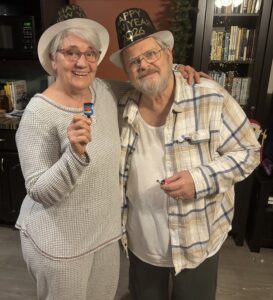
 I post once a day on my three Facebook sites and Instagram. For the most part, the posts are happy, upbeat, and about family. I do this for my readers, and I also do it as a way of documenting my family. Someday, these posts will be a series of books called 365 Days, 365 Ways to Be a Family.
Here is a post I made in September –
Two Wednesdays ago, August 20th, Don had a right hip replacement. He is recovering well, and it is a relief to have the pain gone. He has suffered for over a year while insurance, etc., was being worked out. This last Wednesday, September 3rd, I had a right hip replacement. Yikes, are we nuts or what? The fun part is that we are exercising together and doing PT together. Makes it a bit more enjoyable. I am only two days out, but I am doing VERY well! Thank goodness.
This elicited a response from an old friend: Hope you both recover quickly! I love how you make the best out of any situation. Kristine A.
Two weeks after this response from Kristine, my life went into the dumpster. I realized that most of what was happening would never be known by my family, followers, readers, and friends. Why? Because I wouldn’t talk about it or post about it. Why?
Almost thirty years ago, I began my journey to accept what God had told me when I still lived in Montana: You’re 100% responsible for your response. You cannot blame circumstances or others for how your life feels. I’ve written about this experience and the fact that it took over ten years to stop being mad about this information and to accept it; five years while still in Montana with a struggling family, and five in Utah, as I worked to understand this truth.
A few years after arriving in Utah, I took a class from Kirk Duncan at Three Key Elements. In that class, we talked about negative energy and how harmful it can be to spill yours onto someone else. They shared healthy ways to deal with negative emotions and experiences, without dumping on others. Then, I took several classes where I began learning that how I perceived a thing, my story, was within my power to control. It was a lot to take in, but I was eager to learn the truth of what I had been told by God and stop fighting against it.
Two weeks after my surgery, when I began struggling, I thought about Kristine’s comment. I was reminded how important it is that those I care about know I’m not perfect, my life is not perfect, I struggle, and I still must work and practice to live true principles.
I’ve thought a lot about this over the last few months, since my surgery, and I decided to share some of what I experienced because it may be valuable to you when things go wrong in your day or life.
It’s imperative to understand that no one’s life is perfect or pain-free, and no one responds well all the time. If we believe this, then we are less likely to compare ourselves to others because we know we do not have the whole story. This is true even of those we are close to.
After my hip surgery, I was told I would recover faster than Don because of my pre-surgery activity. I needed to bottle salsa because we were out, and my surgery was on the 3rd of September. I asked the PA if I could do this before the canning season passed. He said, “You can do anything you have energy for. Your new hip was made to stand on.” I took him at his word. I was going up and down our two steps the day I got home from surgery, doing my regular caregiving things, dozens of times. A couple of days later, I was making salsa. It turned out great.
At the end of week two, I began having deep feelings of discouragement, depression, and anger. I was diligently trying to do what my reader said I was good at, making the best of any situation. I wasn’t succeeding, and I began to struggle with my story. Because Don was pain-free and I wasn’t, I must have hurt my new hip. I was a nitwit to keep up my caregiving routine, cooking, doing laundry, etc., and not spending more time sitting and resting. My husband was incontinent after his surgery, and I had to wash 4-6 pairs of outer pants every day. My mom still had dementia and needed help with everything. I didn’t see any way out. Because I was up and about and looked great, no one realized what was happening in my head.
I couldn’t lie down without pain, so I had to sleep in a borrowed recliner for two weeks. Don was in the other one. I need darkness, and he needs light. I wake at the slightest sound, and he can sleep through anything. I wasn’t getting good sleep at night. I woke up often. I would look at the clock each time and say to myself, “Agggg, I only slept an hour and a half. What’s wrong with me?!” Every day was filled with fatigue, but I am who I am. I would get up and do what needed to be done. It’s my nature, but it added to the mental and emotional stress I was feeling. A full month passed.
Despite not understanding what was happening and feeling so discouraged, I pondered and prayed a lot, searching for information, resources, and solutions. I kept reminding myself that I have control over my story and how my life feels. I knew I needed more information than I had, that I needed help. Experience had taught me these things, and even though I wasn’t managing well, I remembered. I knew I needed to take a step.
I finally did a wise thing and sought support. I talked to my daughter. She had already begun seeing that there was a problem. She has a 19-year-old special needs daughter and three other teens. I didn’t want her to pick up any of my load, but I knew I needed help. She began doing small things whenever she came into our part of the house. She emptied the potty in Mom’s room, put more pants and Depends in the bathroom for Don, filled water glasses, did a load of dishes, etc. She asked me if we would share her evening meal, so I didn’t need to cook three times a day. She’s been sharing dinner with us for three months now, and some days I know it was a lifesaver. Beginning today, January 1, I’m taking it back. I’m ready. : )
Remember those prayers I said and the pondering I did? I was seeking information and resources. A week after taking that small step and talking with Jodie, a resource came. I have a scheduled call with my friend Joy every month. I got brave and told her the facts about where I was mentally and emotionally. She reminded me of a tool I knew about but hadn’t thought to use, tapping for health. I took her advice and put the tapping instructions on the wall across from the toilet. I began tapping every morning while saying my truth statements/affirmations. From the first day, I felt different. I could feel the anxiety, mental fog, and depression lessening.
Joy also mentioned that depression is part of healing and wasn’t happening because I was weak. What!! Could this be true? Here was new information. A light bulb went on, and I felt that what she was saying was true. In that moment, the story that I was a nitwit or had hurt myself caved in.
That same week, I got brave and mentioned how I was feeling with Laurie, the hospice nurse who comes and checks on my mom. She said, “Mary, depression is part of healing. It’s a reminder to rest and breathe. You’re OK, and it will pass.” There was my confirmation of the new information I had gotten from Joy. Laurie also told me that when we’re healing, we wake up at night because it requires energy to heal, and most of our healing occurs at night. So, waking up was also OK. Whew. Now, when I woke up, I would say to myself, “Wow, you’re doing some great healing!” The old story disappeared for good, and a new story took its place!!
Within a few days, I was feeling more myself. Within another month and a half, the fatigue was almost gone, and I could manage much better. I’m now four months out from hip surgery. Don has no hip pain, but I still do, occasionally. I know I haven’t hurt myself or overdone it; it’s just my healing process. I’m staying on top of my story. To solidify my story, when Don’s physical therapist came this last Wednesday, I asked him about it. He laughed and said something like, “You’re so busy. Sometimes your hip reminds you it’s still healing, but you’re OK.”
Here is the point
of this very transparent, vulnerable, and lengthy article – we are all doing our best, but it isn’t always enough. There are times when we need help, more information, and resources.
When I was in trouble, I utilized what I had learned from experience. When you’re struggling, they may help you.
1. Don’t dump your negative stuff on people. If you’re feeling negative, sit in the car and yell. Go outside and hug a tree and dump out all your frustration and anger, all your hurt.
2. Then begin seeking solutions. Take charge of yourself. Be willing to take a small step.
3. Ponder, pray, read, talk to a friend, whatever works for you, and seek information and resources. They are there, but you must take a step to find them. You must move. My first step was talking to Jodie. I wish I had done it in week two and not a full month out. I wouldn’t have sunk so far, suffered so much, and would have made quicker healing progress.
4. Remind yourself you’re in control of your story. If it stinks, take charge and do what you need to, to rewrite it. Stay out of blame, even if you want to blame the young P.A. for his youthful words. : ) You are 100% responsible for your response to whatever is happening.
5. Never judge yourself by what is happening on social media, in your neighborhood, at church, or among your friends. Comparing is always a slippery road to take.
The Truth
I put my best out there because I can help others when I do, but I am not always happy, gentle, cheerful, or in control. I have tough days, and I’m always working on a story of some kind. Just know we are pretty much all alike, succeeding and failing at the same time, and it’s OK. Here’s something I say to myself every morning. It’s one of my truth statements/affirmations: Every day, in every way, I am better and better.
Please know I will always tend toward the positive because I have spent over 30 years learning how to take responsibility for myself and my life, regardless of circumstances or what others do or say. I am practiced at it. Also know that I struggle still. Life has its ups and downs. There’s always something new to experience and figure out. Sometimes I’m successful in an effort, and sometimes I fail. That is life.
I want you to be brave and do what I have done. Practice taking 100% responsibility for you. Forgive others. Forgive yourself. Talk kindly to and about yourself, even when you mess up. Give others and yourself grace. Be patient when you don’t know what to do, even if it takes years to figure out. Remember, it took me ten years to stop raging and another ten to accept that I had 100% responsibility for my response. If you keep pondering, praying, learning, growing, and changing, you will find the resources and information you need.

 The article I had prepared to post on November 30, 2025, had been published in 2017. My Excel sheet wasn’t as in order as it needed to be. Instead of getting another article ready at the last minute, I wrote a note to my readers and sent it out via the Sunday newsletter. It made an impact, and I got emails. I realized that I had written an article with an important message without even knowing it. So, I’m posting it on the website and recording it. If it helped last Sunday, then it may be of help in the future. So here you go:
 Several years ago, I wrote an article about
 In an article I wrote in September 2024, titled
 This week, I had an experience that brought to mind the importance of letting our kids know, daily, that we see them and that they matter. It brought back many memories of families I have worked with, parents I have mentored, and the huge impact I’ve seen when
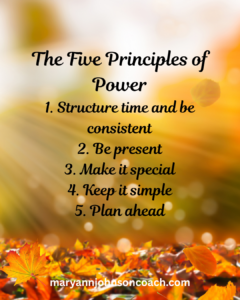 Recently, I wrote about principles that I consider powerful for a healthier and happier family life. Last week, we delved into principles one and two. Today, I will share information and examples on principles three and four.
 As I’ve mentioned before, there’s a story that has caused me grief. I’ve worked on rewriting it, but it continues to morph as I move into my 9th year of caregiving. Despite the work I’ve done and the changes I’ve made, it still rears its ugly head and causes negative emotions. When it does, I take immediate control and look at how the story has changed. It’s annoying and sometimes exhausting to rework an old story, but this one has been particularly tough. I suspect that’s because, as a caregiver, I live a life that makes it easy for the story to creep in.
 A few days before my 54th anniversary, May 28th, I spoke to my good friend, Joy. I had been down with bronchitis for three weeks. I was challenged to keep up with caregiving and was feeling down, not at all like myself.
 Remember that monthly call I have with my friend Joy Petty? We had another invigorating conversation I want to share. I’m no expert on this topic, but I have had experience with it. Joy is an expert.