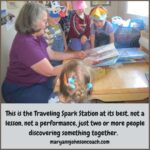
When my daughter, Jodie’s, children were young, I lived two blocks away. When I was caring for them in my home, they loved the Spark Station. But I wanted to connect more often, so for several years I would take my Spark Station traveling to their home. I didn’t stop there. I took it to Washington and Colorado to connect with my faraway grands. I used it at events with children. I wanted a better connection with all the children in my life. It came to be called the Traveling Spark Station.
This four-part series is for anyone who loves a child but doesn’t live with them every day — grandparents, aunts, uncles, family friends, anyone who wants to show up and really connect. The Traveling Spark Station is simply a basket, bag, or box filled with books, supplies, and simple activities built around a single topic. You choose the topic. You pack what you need. And then you go.
Over the years, I wrote dozens of articles about the activities I did with my grandchildren — the topics we explored, the crafts we made, the books we read, the messes we made, and the memories that stuck. This series pulls those articles together into one place. My grandchildren ranged widely in age, and the internet makes it easy to find activities on any topic for any age. Books matter too. Reading together, even with the littles piled in your lap, builds connection in a way that nothing else quite does.
Sincethe Spark Station is for fun, learning, and connection, not everything has to be useful. Some activities are simply for the joy of it.
1. Empty Toilet Paper Rolls I spent a few months collecting toilet paper rolls for an event where I created a Spark Station for 140 children. When it was over, I had many tubes left and started pondering how to use them. I googled “toilet paper roll crafts” and then tossed a bunch in my basket. No matter the topic, the season, or the holiday, you can find a craft made from toilet paper rolls. Some are great for pre-teens, and your teens will love helping the littles. You’ll be amazed.
2. Empty Water Bottles We had the same kind of delight with empty water bottles. A water bottle collage, a landscape in a bottle, a baby’s rattle, a bird feeder, the options are endless, and there is something for every age online. Save those bottles and have a fun family activity. Why not start with a water fight and then make a craft?
3. Pretend Play I did something scary for the Traveling Spark Station: I played pretend. I have done crafts, sewing, cake decorating, and gardening with hundreds of kids. But imaginative play? By the time I was fourteen, I had completely stopped pretending. I would build fabulous play spaces for my siblings (I was the oldest of nine) and then step back and let them play. I did the same with my children. I watched and enjoyed it, but I never entered the game.
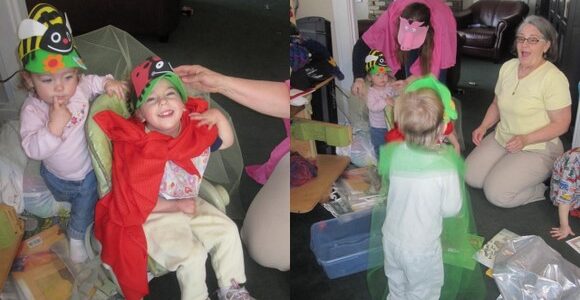
I decided to try. The Traveling Spark Station held books that could be acted out, and a pile of large fabric squares. We read several stories together and then acted out The Little Red Hen. It was an interesting afternoon, and I genuinely enjoyed pretending with them.
4. Doing Nothing Special I don’t want you to think every Traveling Spark Station activity needs to be carefully planned and filled with fabulous ideas. Some days you’re tired. Some days, circumstances intervene. One day, I showed up with no library books, no internet research, and no topic in mind.
We made cinnamon snakes from packaged biscuit mix, not because we were studying snakes, but simply because the children love to cook. My husband was building an air gun shooting range and had cut out small wooden animals as targets, so we helped paint Grandpa’s animals. That was it. We had a lovely time, helped Grandpa out, and enjoyed being together. Sometimes that is exactly enough.
OUR BODIES
1. What Can a Body Do? One summer, the Traveling Spark Station had no projects and no crafts — just pure outdoor fun and movement. I wondered about Maggie, who was five and had severe cerebral palsy. What she can do on her own is very limited. But she has a body, and she likes to use it, so we went ahead. We walked. We smelled the air. We fed the ducks. We watered the garden. We felt flowers, leaves, and prickly stickers. We waded in a stream at the city park, swung on the swings, jumped, and ran. Then the long walk home, squinting into the sun. We ended with the book Sleep, Little One Sleep by Marion Dane Bauer. Our bodies and our eyes were ready for a rest.
2. Learning About Bones Learning about bones was a laughing good time. We played a bone identification game by tickling our rib bones, neck bones, backbone, and hip bones. We talked about the difference between skin and bones: bones hold us up, skin holds us together. Skin is soft and can tear; bones are hard and can break. We talked about keeping both healthy and strong.
For activities, we traced everyone’s body on large pieces of paper and drew in the bones: head, spine, arms, legs, hips, and chest. Hanging the finished bodies on the wall was the most exciting part. We also made a Q-tip skeleton, read three wonderful books, and yes — we found a use for those toilet paper rolls too. : )
3. Toilet Training You can put anything in a Spark Station, including potty training support. Jodie asked me to come up with fun ways to reinforce progress for Jack, who was in the middle of training; Mary, who wasn’t ready yet; and Maggie, in her wheelchair, who never would be potty trained. I want to be honest, there’s no way to make this topic relevant to older children. Sometimes the Spark Station holds something just for one or two kids, and that’s perfectly fine. This tool is versatile.
I had potty training books, of course. Jack was absolutely riveted; his interest could not have been higher. Maggie practically had her nose to the page as we read a story about a girl and her potty. She wasn’t interested in sitting on one herself, but she loved the stories. For our activity, we made a paper potty train to hang on the wall with prizes taped above it. Jack got to move the train down the track each time he used the potty. Maggie and Mary, in their own stages, got to move it when they brushed their teeth.
4. Germs and Hygiene Jack, Maggie, and Mary had all been very ill for two weeks, which seemed like a good time to learn about germs. We looked at pictures of germs, watched a funny video of germs with cartoon faces, and used yeast and sugar to show how fast germs multiply. We practiced hand washing while singing the Alphabet Song. We spent less than an hour together. There was some chaos and a lot of laughing. Worked out great.
READING & WRITING
I love to read. Being able to read matters deeply to me. I wanted my grandchildren to love reading. That’s one reason the Traveling Spark Station always carries books, and one reason family reading time is worth protecting.
1. Mother Goose I had a book of Mother Goose rhymes and found some wonderful, themed lunch ideas the kids could help me make. I made do with what I had on hand rather than running to the store. As we ate our Humpty Dumpty lunch, we read rhymes. I had made a few toilet paper tube puppets ahead of time, and we acted out Little Bo Peep, Mary Had a Little Lamb, and Baa Baa Black Sheep. Then we made Humpty Dumpty finger puppets to play with while we ate.One grateful mom sent me a note afterward: “Mary Ann, you are such a genius. The nursery rhyme-themed lunch and the puppets look amazing. I had never thought of anything like that.”
For children over six, try letting them create their own Mother Goose book for younger siblings, or look up the surprising history behind the rhymes. Ring Around the Rosie is a great place to start.
2. Letter Recognition I had planned a letter recognition activity for 1-year-old Mary, 3-year-old Jack, and 5-year-old Maggie. Then, at the last minute, I discovered I would also have a 10-year-old, a 7½-year-old, another 5-year-old, a special needs 4-year-old who was blind, a 13-year-old, and a 15-year-old. Yikes.
I pulled out books and asked the children what they had in common. The older kids had a lot of answers. We played a letter recognition Memory game with alphabet cards — Christopher, the 10-year-old, loved it. Maggie dove into the worksheets, which are her favorite, and the other 5-year-old and the 7½-year-old joined her, delighted to be playing school. Annie, the 13-year-old, took pictures for us. Jason, the 15-year-old, settled in with Pride and Prejudice. He and I had a great conversation about Great Expectations while the littles played their card game. The Spark Station connects people regardless of age. Every time.
3. Family History A fun way to inspire children to read and write is to start with family history. My grands had a ball looking at photos and hearing stories about their parents when they were young.
Another mom, Annette, tried this with her older children. A scrapbooker by nature, she had originally planned to create a memory book for each child from everything she had saved over the years. Instead, inspired by the Spark Station, she let each child explore their own box of treasures. They spent the whole activity telling each other stories and peppering their mom with questions.
Compiling a photo album and labeling the pictures together is another wonderful idea. Even children who can’t read yet will enjoy this for short stretches. Put some family history in your Traveling Spark Station and let the children celebrate the story of their own lives.
4. Classic Stories Pack a few classics in your Traveling Spark Station for whatever age you’ll be with. Classics spark imagination and a genuine desire to read in a way that few other books can. Two tips I learned from my friend Rachel DeMille years ago have stayed with me: first, read with the intention to interact, not just to get through a chapter. Ask questions. Talk about what’s happening. When my Spark Station traveled to my grandchildren in Washington, this was one of their favorites. Second, take a little time to learn about the book you’re reading, whether it’s The Three Little Pigs or The Secret Garden. Your questions and conversation will be more interesting.
5. Books That Change You One book in my Traveling Spark Station that I return to again and again is The Hundred Dresses. It’s about generosity, charity, and kindness, told through the eyes of young girls who learned these lessons the hard way. This book was impactful to me as a girl and changed how I treated other people, and it still does, every time I read it. That is what a classic does.
Think about the books that have changed your way of being. Those are worth sharing with the children and grandchildren in your life.
6. Books for Teens and Young Adults I still read children’s books and young adult novels, and I freely admit it. They are fun and often say more than adult books.
One book I picked up by accident was The Lost DaVincis. It wasn’t until chapter three that I realized it had been written by my friends Aneladee and Don Milne. That made it even better. You know you have a good book when it makes you think. If it makes you think, it will do the same for a young reader. I decided that if I were eleven, I would be waiting breathlessly for the sequel. What a perfect Traveling Spark Station book. If you want your kids to read, read with them. Talk about the books. Take them along wherever you go.
7. Fables and Tall Tales Fables, tall tales, and fairy tales are wonderful Traveling Spark Station territory for children from littles to teens. I checked out a wonderful assortment from the library. Reading through them gave me activity ideas.
I chose fables from Bali, Zaire, Mexico, two from Native American traditions, and one from America. When I asked Jack what he thought a fable was, he replied, “A monster.” We had a good laugh, and then I explained that it was a pretend story, and that every country in the world has its own pretend stories. I spread out a large world map, and we found each country together — Jack and Maggie were too young to fully grasp maps and continents, but I wanted to plant the idea.
We had simple crafts connected to each country: a tipi craft, a game, and a coloring page. Despite being so young, both loved every minute. This topic is rich enough to stretch across several family activities. You could even eat a dish from each country whose fable you read.
You’ve just seen how much ground a Traveling Spark Station can cover, from silly toilet paper roll crafts to classic literature, from tracing bodies on butcher paper to acting out The Little Red Hen. Some of these activities took careful planning. Some happened with a box of biscuit mix and whatever was on hand. All of them mattered.
That’s the thing about this tool: it doesn’t have to be perfect to be meaningful. It just has to be yours: your curiosity, your presence, and your willingness to show up.
In Part 2, we’ll keep going. We’ll look at how the Traveling Spark Station can make math genuinely fun— yes, really —and how arts, crafts, and imagination open doors that worksheets never could.
You may be surprised how naturally these things travel.