Category: The Spark Station

The Spark Station in Action: Real Families, Real Results Part 2

Let’s Begin where We Left Off – Keep It Simple: When It’s Full, Stop

Here’s a rule I wish I had understood earlier: when your Spark Station is full, stop adding things. You want everything visible, easy to reach, and put away — then stop. If you want to add something new, take something out.

Chaos happens when the Spark Station is too full. Here’s the thing — it’s rarely the children who create that chaos. It’s the parents. We get excited. We find wonderful things. We keep adding. And then no one engages because no one can find anything, and the whole space feels overwhelming.

When my grandchildren were younger, I had a Spark Station. One day, I did a big purge. I took nearly everything out. What remained were some books and materials on rocks that my grandchildren had been studying, some new craft supplies for an upcoming holiday, and the magnets — because the children never tired of them. That’s it. Simple, colorful, and interesting.

It also helps to reevaluate the contents every few months. Have children outgrown certain things? Are there games gathering dust, are there completed projects, or supplies that have lost their appeal? Take them out. Nothing in the Spark Station is permanent. It’s a living, changing space, and that’s what keeps it working.

Plan: Keep Your Eyes Open

Planning doesn’t have to be complicated or time-consuming. The mother who found dollar insect items at Target wasn’t sitting at a desk with a planner. She was simply paying attention to what her boys loved, and when she saw something that sparked them, she acted on it.

That’s the kind of planning I’m talking about. Watch your children. Listen to what they talk about. Notice what makes their eyes light up. What does your family like to do together at home — read, play outdoors, create games? Think about upcoming holidays. What’s happening in your family? What did you love as a child? Keep a running list if that helps. Then regularly sit down — even for thirty minutes — and think about what you might add or remove in the coming days. If parents have something specific they want to introduce, they can use the Spark Station to get the ball rolling.

Every Family Is Different — Don’t Be Afraid to Re-Tool

My daughter, Jodie, has four children, all of whom are teenagers. When she first started using the Spark Station, they were 7, 5, 3, and 18 months.

Jodie had decided to homeschool for a couple of years. Jack, her five-year-old, was convinced he needed a ‘real teacher’ — meaning anyone other than his mother.

I helped Jodie put together her first Spark Station. We chose wonderful hands-on items — sewing cards, coloring books and fresh crayons, magnets, a salt shaker with toothpicks to drop through the holes, dry-erase boards, games, books, colored pencils, and notebooks. We also added several special science projects, a family interest: a homemade coloring book, library books about scientists, a mobile to make, and a baking project.

The night before their first official use of the Spark Station, Jodie helped her kids make Earth spheres out of Rice Krispies treats, a family activity not part of the Spark Station. The kids loved it. They discussed how the Earth was created and how scientists continue to learn more. Jack was all over it.

When the Spark Station was opened, Jack took one look and said, “Mom, your school is boring. I’m going to cancel your school.” Disaster.

So, Jodie re-tooled. She removed the special learning projects. The simple, fun, hands-on items remained. The little ones dove right in. And Jack? He looked up and said, “Mom, I want to learn about knives.”

Jodie got a few knives, a tomato, and some potatoes. They spent the next hour learning about serration, sharp edges, how knives are used, and what it means to observe — which, as it turns out, was the exact topic of their first science project. Fabulous time. Sneaky mom.

The lesson here is not that you will always get it right on the first try, whether you’re using it as part of your school ambitions or for family activities. The lesson is that when something isn’t working, you step back, take a good look, and retool. Every family’s different. The rules stay the same, but how you apply them will be uniquely yours.

What About the Hard Days?

There will be times when your carefully planned Spark Station sits untouched while your child plays dress-up in the corner. There will be days when the baby’s screaming, the toddler’s grabbing everything in sight, and you wonder why you ever started this. There will be days — and I say this with love — when your five-year-old looks at everything you’ve prepared and tells you it’s boring. There will be days when you take out a book for family reading and your teenager goes to sleep. There will be days when you get the materials for a new outdoor game, and your 13-year-old daughter sits glumly on the sidelines because this doesn’t interest her.

That’s normal. In nearly every family I’ve mentored, we’ve had to talk about this. The Spark Station is designed to inspire families and kids, not require.

If today’s a disaster, remember the thing that matters most: the Spark Station’s greatest purpose is not the activity, it’s the connection it creates between you and your children over time. If no one wants to engage today, sit down, read, or talk about an upcoming holiday, trip, or family event. Next time will be better.

You Are the Model

I once asked a mom what had drawn her to my class on the Spark Station, though she had never heard of it before. She said she read the description and thought, “That’s a good idea.” The line that caught her eye was this: “Would you like a system that helps you more effectively structure creative connection time?”

That’s it. That’s what we’re all looking for. Not a perfect system, not a perfectly stocked Spark Station, but a reliable, workable way to show up for our children and make being together, playing together, and learning together a joyful part of family life.

The Spark Station gives you that system. But you’re still the heart of it. If you want your children to love learning, let them see you learning. If you want them to read, let them see you reading. If you want them to be curious about the world, be curious yourself. If you want them to engage with the family, then put down your phone, turn off the TV, and engage with them consistently. You put on your oxygen mask first, and then you help them with theirs.

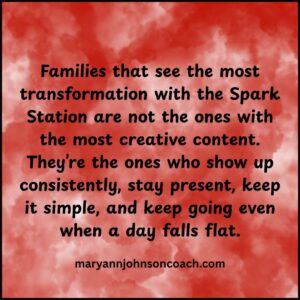
The families who see the most transformation with the Spark Station are not the ones with the most creative content. They’re the ones who show up consistently, stay present, keep it simple, and keep going even when a day falls flat.
That’s the whole secret.
And now you have it.

The Spark Station in Action: Real Families, Real Results Part 1

I want to tell you about an experiment I did years ago. I had been talking to families about the Spark Station and quickly realized that something wasn’t clicking for a lot of them. They liked the idea, but it wasn’t working the way it should. I could see clearly that these parents were missing the vision of the real power this tool could have in their homes. So, I decided to test what I knew worked with real families — five of them, over two months.
The families were wonderfully different from each other. One had three children ranging from a newborn to three and a half, with the oldest having severe cerebral palsy. Another had three children ages six, ten, and twelve. One family had five children from ten months to eight years. Another had four children, ages five to sixteen. The last had five children, ranging from a newborn to ten. I talked face-to-face with parents and children, and what I learned from those two months shaped everything I now teach about the Spark Station. What I found was this: the tool itself wasn’t the problem. The principles behind it were.

It’s About Five Rules, Not the Stuff

I want to share a letter I received that illustrates this perfectly. “I had to send off a quick thank you for your help. The Spark Station is transforming our family learning experience and fun! Last Saturday, I found dollar insect items at Target. We are having a blast. I almost passed up the big plastic insects as ‘toys’ but realized, no, they are inspiration for my little boys and models for insect body parts. What was I thinking?”

Isn’t that a great letter? I have received many such letters, but here is what I want you to notice. This mom thought it was about the plastic insects. It wasn’t. It’s about a mom who was focused on inspiring her boys. It’s about a mom who meets with her children consistently and stays present. The insects are wonderful, but they are not the magic.

The magic’s in the Five Principles of Power. I’ve said this before, and I will keep saying it, because I want you to be convinced that these rules work, not just in learning but in family connection and fun.

Here they are:
1. Structure time and be consistent
2. Be present
3. Make it special
4. Keep it simple
5. Plan ahead

Understanding them deeply is what makes everything else work. I introduced them last week, but now I want to illustrate how the rules work in real families. Let’s start with the first three.

Structure and Consistency: Honor the Time

Once you have set a time for your family to use the Spark Station, honor it. Consider it sacred. I received an email from a mom who had just gotten her Spark Station ready and structured some family time, when every child came down with a cold. She shelved the whole thing for a week.

I understand. I raised seven children, and I know what it feels like when everyone is poorly. But here is what I told her: Hold to the time, even when life gets in the way. Modify it — gather your children, read for a few minutes, give everyone a glass of juice or hot chocolate, and call it good. The point is consistency. It allows your family to depend on time together, to know they can count on family time.

Illness isn’t the only thing that will challenge you. There will be days when you’ve made more commitments than you can manage. We all do it occasionally. When that happens, gather your children together, begin as you always do, read briefly, or visit about something important to your family, and call it good. Something is always better than nothing; your family will appreciate the consistency.

Be Present: The Real Gift

Being present is a gift — to whoever we give it to. It means listening without texting, checking email, or watching TV out of the corner of your eye. It means being all eyes and ears for what’s happening right now. Families feel more secure and happy when parents are truly present, and that feeling is the heartbeat of the Spark Station.

A reader once wrote to ask whether she was supposed to put activities in the Spark Station and observe, rather than jumping in with her own ideas. She worried that it seemed counterproductive to have a learning agenda when the whole point was connection.

Here is what I told her: when you’re working with a child under six, they usually want you to play with them and be with them. For them, it’s all about being with you and having that warm family feeling. That is the connection. Your learning agenda is simply what you choose to put in the Spark Station. Once it’s open, follow their lead.

Regardless of what is in your Spark Station, let each family member choose what they want to engage with. If it is on Sunday, everyone will be there. If it’s to unwind after school, just the kids and you, etc. If they ask questions, answer them. If they want you to play, play. If they seem content exploring on their own, let them.

Make It Special: The Siren’s Song

One dad described the Spark Station this way: “It’s like Christmas. The excitement stays because it isn’t available all the time. It’s amazing!”

He’s exactly right. The Spark Station only sings to children and family when it’s treated as something special — available at certain times, consistently, so it can be counted on and looked forward to. That anticipation is powerful.

I received a letter from a mom named Pam whose ten-year-old had just discovered cross-stitching materials in their Spark Station. She had only gotten three stitches in before lunch, and Pam knew her daughter would be frustrated not to continue. She asked whether there was ever an exception to keeping a project in the Spark Station rather than letting a child use it freely.

Here is what I told her: keep it in your Spark Station, and here is why doing so works in your favor. Your daughter isn’t bringing you a wad of tangled thread when you are up to your elbows in bread dough or separating squabbling siblings. The project’s also safe from the curious two-year-old, the interested six-year-old, and the teasing ten-year-old. A twelve-year-old girl told me what she loved most about the Spark Station. She said, “When you’re working on a cool project, and you have to stop, you’re excited about getting back to it ” Kids get it.

This principle works with things that are new to your family — cross-stitch, calligraphy, woodworking — and it works equally well with things they have had forever. I’ve seen parents take a book off their bookshelf, one their children have walked past for years, put it in the Spark Station, and suddenly everyone wants to read it. One young girl asked her mom to put a geography game in the Spark Station. It had been unused for over a year. Once it went in, she and her siblings played it many times.

As for how long an item stays in — it doesn’t matter. A day, a week, a month. When it comes out, its Spark Station life is over, and something new takes its place.

That’s the cycle that keeps the magic alive.

The Spark Station: Everything You Need to Know to Build One

When I was in fifth grade, I learned to crochet. It wasn’t easy to learn. I had never done anything like it before. I felt all thumbs, and it wasn’t always easy to conceptualize what it was I was supposed to do. With time, I did learn, and I made a small purse. My teacher coached me through almost every row until it was done. I still have that purse.

The next hurdle was learning to read actual directions. Yikes. It was like reading Greek. I had learned how to crochet, but without a teacher constantly at my elbow or being able to read the directions, I couldn’t really use my new skill. To learn to read directions, I had to go back to the beginning and learn to connect the skill with the actual execution of a pattern.

The same is true for the Spark Station. You may have heard me mention it, but hearing about it and actually creating and using one are two different things. This April, I’m going to give you the instructions you need.

Why The Name Change

When I decided I needed a new name for this amazing family connection tool, our youngest child was having her first baby. We were all excited about it.

When a new baby comes to a family, a lively search for a name ensues. The mother-to-be probably has a few she has carried in her head since she was a girl. The father may have a football hero or two with names he really likes. Our daughter and her husband went through quite a list looking for the perfect name.

The question is, how to choose a name? For our first child, we watched a movie. Two weeks before our due date, we still had no names picked out. Back then, you didn’t know which you would have, so you had to have two names ready. We were watching a Disney movie, and, in the credits, we saw the name Jodie. Eureka, the perfect name – perfect for no other reason than that it sounded good, and we liked it.

With all our other children, we went through a similar scientific process. One was named after a best friend, one was named after a song I liked, one came from the Bible, another was named…and that’s how it went. Later, I realized each name had a meaning and energy attached to it. Maybe we should have put more thought into choosing them, but you can’t go back and change a child’s name. For better or worse, it is what it is.

Fortunately, that’s not true in business! I knew I wanted to change the name of my family connection tool and searched for the perfect one for over a year. I wanted to make the change for several reasons.

•My printer said he loved my Closet Mastery Course, teaching how to use the tool, but had to look inside because he wondered if I was training people to come out of the Closet.
•When people asked me what I did, and I told them I showed parents how to create a Closet to connect as a family, I got confused looks and then the inevitable “So, how does a clean closet help them connect as a family?”
•Many parents told me they loved the tool but didn’t have a closet to use and were stuck.
•It seemed odd to call the tool The Closet and then tell people they could use a box, a bag, a drawer, or any container they liked – or even no container at all.

The name was problematic. I needed a name that spoke to what the tool was all about. I wanted a name descriptive of what made the tool so effective in helping families connect and making learning fun.

The Spark Station. I love that name. Let me tell you what the Spark Station is and how it can change the way your family connects.

The Spark Station

The Spark Station is about what’s inside, not what holds it. It can be a box, a plastic tub, a drawer, a closet shelf — or no container at all. It’s a place for cool learning and connection materials that inspire your children and bring your family together.

It’s designed to allow children to choose from several activities and topics of interest and engage with them in their own way. When used correctly, it’s very helpful in relieving the tension that comes when parents require children to stay together as a family on a Sunday afternoon, learn about a topic they may be struggling with in school, or stop arguing on a boring Saturday afternoon.

The Spark Station isn’t just one thing. It looks different in every family, and sometimes there is more than one, depending on the activity. Take the Sunday Box, for example, a box filled with cool stuff that helped a real family gather on Sunday afternoons. That’s the beauty of the Spark Station. You can showcase things your children are already interested in, you can gather to learn something new together, or just have fun. It keeps interesting and inspiring materials close at hand, so children and families have a magical and exciting place to learn, play, and connect.

There are Rules for Success

Whatever your Spark Station looks like, it’s only available at certain times. It isn’t a space that children can access anytime they want. Doing this preserves the sense of anticipation that makes it sing to kids, like a siren’s song. In Leah’s family, their Spark Station (The Sunday Box) was only available to the family on Sunday. Another family that homeschooled used their Spark Station during their school hours. Another family made their Spark Station available for an hour after school so kids could unwind. This builds value and interest in the content.

During the time you have set aside to learn, play, or be together as a family, you gather together for the amount of time you have pre-determined and open the Spark Station.

Not every child will want to engage with the content every time it’s available. They should be free to play with whatever takes their fancy — or even just read or write instead. They need to remain with the family, but they don’t have to engage with the Spark Station contents. When that happens — and it will — don’t be discouraged. I know, you worked hard on that Spark Station! But this is normal. In almost every family I’ve mentored, we’ve had to talk about this. Allow your children the freedom to decide.

The Spark Station is a tool that helps parents inspire their children, at all ages, to love learning, to experience new things, and to connect as a family. It brings scheduled, consistent moments of discovery and joy into your home — and those moments matter more than you know.

This April, let’s build one together.