
 When my grandchildren, Jack and Maggie, were small, I helped them make a chicken basket for Easter. It was made of two paper plate halves glued together. The pattern had the chicken facing sideways, with one eye glued on and a wing drawn on one side.
When it came to gluing on the eyes, Jack had a fit because in his mind it needed two eyes. I explained that the chicken was standing sideways (I demonstrated “sideways”) so you only saw one side. He kept saying it needed two eyes. “See, it has a mouth.” He pointed to the wing, which he was sure was the mouth. No amount of explaining could change his mind. A chicken with a mouth needs two eyes!! I let him have two eyes.
When my oldest daughter, Jodie, was four, her dad was fired from his job. Don and I talked a lot over the next few days as we contemplated what to do. After a few days I noticed Jodie drawing a picture. She had drawn a stick man with scribbles in red all over him. I asked her to tell me about the picture. She said, “It’s daddy. He is fired.” As we talked, I realized she was worried that he was going to burst into flame any minute. I mean, he was on fire, right?
One day while visiting Jodie’s home, before we consolidated our households, I was teaching the kids how to churn butter. I had an old butter churn with wooden paddles that I had inherited from my grandma. Because churning butter takes so long, I made the statement that before we got it done, we would all go grey. When the butter was finally finished, Jack seemed disappointed. He said to his mom, “I thought we were going to turn grey.” He was talking about our bodies, not our hair. : )
When Jodie was five years old, she took a potato peeler and peeled the slats on the baby crib until they were about half an inch thick. She did this on four or five slats. When I asked her why she did it, she said she wanted to see how the peeler worked. I assume it was so fun to watch the wood peel off that she just couldn’t stop. : ) It wasn’t funny at the time.
Another day I took some long bubble wands to my grands so we could blow ginormous bubbles. Jack was standing by the front door, holding his bubble wand and anxious to go outside. When I looked at him, he was staring at me and holding the bubble wand sideways as all the soap spilled out. I thought he had done it on purpose because he wanted to see it spill.
I said, “Jack, what are you doing?” My voice wasn’t mad or loud, but it was startled. Jodie looked over and said, “I’ll get a cloth.” She is a calm woman by practice and decision. I stepped on the cloth, sopped up as much soap as I could, and then we left the mess until later and went out to blow bubbles.
Outside I watched Jack tip his wand sideways and begin to unscrew the lid. Then I realized what had happened in the living room. Jack was unscrewing the lid in what felt to him like the most natural way. I said, “Ah, Jack, I see what happened in the living room. You weren’t spilling the soap on purpose. Let me show you how to keep it from spilling.” Then I showed him how to hold the wand upright and take off the lid. He never spilled any more soap.
All these examples are funny now. Kids do say and do the darndest things. That’s because they think differently than adults. They take things quite literally. They don’t understand the multiple meanings of words. They aren’t familiar with idioms. They need to figure out how to do many things, and they aren’t always aware of the best way to get a thing done. Sometimes our seemingly simple instructions are Greek to them. And like Jack and the bubbles, they don’t always see ahead to what the consequences of a certain action might be.
When a child says or does something that seems naughty, foolish, or silly, it’s valuable to stop and think it through. Often, if we take the time, we will find that their intent was good, just uninformed. Yelling or becoming angry or silent in the face of a child’s mistakes sends messages we don’t really want to send. You’re stupid. You’re naughty. You’re clumsy. You aren’t good enough.
Stand Back and Let Them Figure It Out
Understanding what a child had in mind is the first step. The second is trusting them to figure things out for themselves. One of my favorite examples comes from the children’s book Understood Betsy. Nine-year-old Elizabeth Ann has always been helped over every hard place before she even knew it was there. Then her much feared Great-uncle Henry hands her the reins of the wagon and goes back to his figuring. She mixes up her right and left, pulls the wrong rein, and the horses walk the wagon into a shallow ditch. Uncle Henry doesn’t say a word.
Then something wonderful happens. Elizabeth Ann realizes she doesn’t need to remember which hand is which. If she simply pulls the way she wants the horses to go, they will never know the difference. The author says it may have been her brain waking up, because it was the first whole thought she had ever had of her very own.
A little later the horses stop, and Uncle Henry is still deep in his arithmetic. She remembers how the grocer’s boy at home got his horse started, so she slaps the reins and makes her best imitation of his cluck. The horses lean forward and they’re off! She was as proud as if she had started a big red automobile, because it was “the first thing she had ever done all by herself.” She had thought of it, she had done it, and it worked.
This little story from a wonderful children’s book says it all about the value of standing back and letting children learn on their own. There will be mistakes, ruined projects, imperfect crafts, cookies that crumble; but learning to do things for yourself, figuring it out, builds confidence and trust in oneself. Don’t help too much or too soon. Just be present and watch!
So, whether it’s a chicken with two eyes or a wagon in a ditch, remember that if we see children as learning beings and not as naughty people, we’ll be better able to figure out what they had in mind, and we’ll be more patient as they learn for themselves. As we do this, we give children the freedom to make mistakes and learn, which is what it takes to become well-adjusted adults.
 Long ago, after a day that started at 7:00 in the morning and didn’t end until 1:30 a.m. the next day, my daughter, Jodie, said, “Mom, it’s probably a real blessing that you have the grandkids so much. It gives you lots of material for your writing.” LOL

 There’s an idea I keep coming back to: no problem gets solved by the same thinking that created it. We have to

 Story 1
 The Day of Surgery

 I post once a day on my three Facebook sites and Instagram. For the most part, the posts are happy, upbeat, and about family. I do this for my readers, and I also do it as a way of documenting my family. Someday, these posts will be a series of books called 365 Days, 365 Ways to Be a Family.
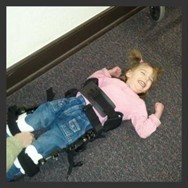
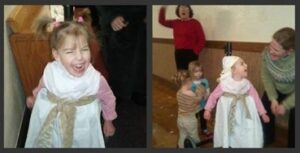 Maggie, my granddaughter with cerebral palsy, was supposed to wear a headpiece. That was not going to work at all. She was supposed to say, “We are afraid”. She said it the best she could, as her ability to speak was minimal, and she said it with a huge smile. She couldn’t find it in herself to look afraid. Many small shepherds were wandering about, trying to figure out where they were supposed to be.
 These children were in luck. Cindy Walker smiled through the chaos. She gently called the small children back into place. She helped with lines that would never be memorized. She replaced halos, headpieces, and robes, and kept smiling. She didn’t laugh out loud at the silly things the children said and did, even though she wanted to.
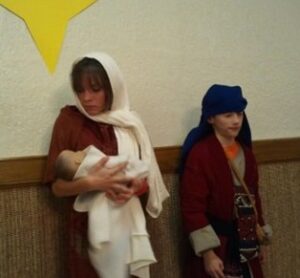 weren’t sure they liked their parts, especially saying, “I’m going to have a baby!” The soldier still felt silly. Headpieces were still falling off, belts were missing, halos still itched, no one remembered where they were supposed to stand, many parts were not memorized, and the little shepherd still smiled when saying, “We are afraid.”
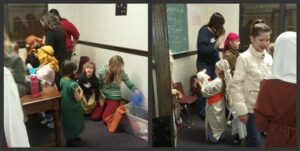
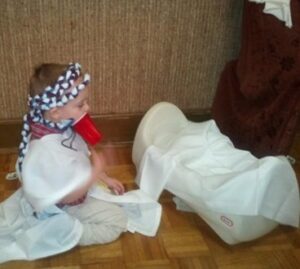 The little angel who wanted to say “Point to the star” wouldn’t leave his dad’s side and come on stage until all the other angels left the stage, and the shepherds were on their way in. Then he went and sat by the baby Jesus and made happy boy sounds with his plastic cup! (This was my grandson, Jack, age 3.) As the shepherds, wise men, and angels gathered around the baby Jesus, it was a mob, juggling each other for a space, mostly with their backs to the audience.

 As I’ve mentioned before, there’s a story that has caused me grief. I’ve worked on rewriting it, but it continues to morph as I move into my 9th year of caregiving. Despite the work I’ve done and the changes I’ve made, it still rears its ugly head and causes negative emotions. When it does, I take immediate control and look at how the story has changed. It’s annoying and sometimes exhausting to rework an old story, but this one has been particularly tough. I suspect that’s because, as a caregiver, I live a life that makes it easy for the story to creep in.