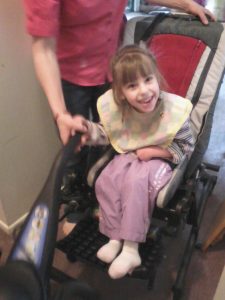
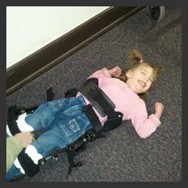
A fun Christmas season activity is watching children perform Christmas plays. When Maggie was five and Jack was three, they had the opportunity to be in a play depicting the First Christmas. All the actors were under eleven, and many were under five years old. Maggie has severe cerebral palsy, which posed challenges; fortunately for her, Cindie Walker, her best friend, was the director. Maggie needed to be placed in a stander to participate in an upright position, without her wheelchair. Cindy had spent a great deal of time with Maggie and wasn’t put off by what was required to work with her. In fact, the beauty of this director was that she wasn’t put off by working with any of the children, no matter how young. She had a vision that I loved. It wasn’t about the outcome, but about how everyone would feel when it was over.
I know you’ll get a kick out of how this play went, what it took to bring it about, the outcome of everyone’s efforts, and the blessing it was for those who performed and watched. I know you’ll love the photos. I also know that it will prompt you to reflect on how you interact with children when things get messy. Enjoy every delightful minute of my long-ago experience. Merry Christmas! As always, there will be a lesson at the end. : )
The First Practice
One of the angels wanted to look like a pirate. He was desperate to look like a pirate and was insistent! All the angels were taking off their halos because they itched. The angel who was supposed to say, “Follow the star”, felt it was more important to say, “Point to the star.” That was his plan come play night.
The Roman soldier kept pulling on his robe and saying, “I look silly.” Mary kept losing her headpiece.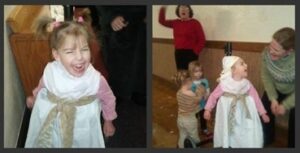 Maggie, my granddaughter with cerebral palsy, was supposed to wear a headpiece. That was not going to work at all. She was supposed to say, “We are afraid”. She said it the best she could, as her ability to speak was minimal, and she said it with a huge smile. She couldn’t find it in herself to look afraid. Many small shepherds were wandering about, trying to figure out where they were supposed to be.
This is what it’s like working with children, especially young or special needs children. You can pull out your hair or feel joy at the experience you’re giving them.
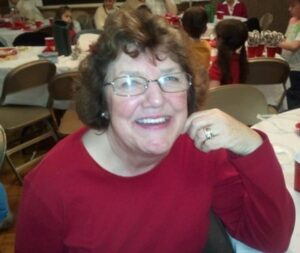 These children were in luck. Cindy Walker smiled through the chaos. She gently called the small children back into place. She helped with lines that would never be memorized. She replaced halos, headpieces, and robes, and kept smiling. She didn’t laugh out loud at the silly things the children said and did, even though she wanted to.
She told me it didn’t matter how the play went. No matter what, she wanted parents to smile, children to feel good, and hearts to be touched. For her, perfection wasn’t what mattered. Even reasonably well run wasn’t at the top of her list. She wasn’t worried about what others would think about the result. She wanted every child to have a wonderful time, to feel proud and happy about their efforts, and for the spirit of the season to be abundant and warm.
The Second Practice/Dress Rehearsal
None of the angels, all 3 and under, would wear their costumes. This did not bode well! Joseph and Mary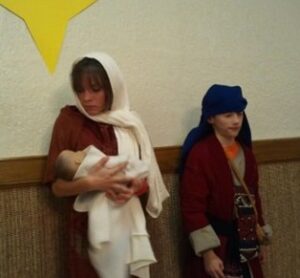 weren’t sure they liked their parts, especially saying, “I’m going to have a baby!” The soldier still felt silly. Headpieces were still falling off, belts were missing, halos still itched, no one remembered where they were supposed to stand, many parts were not memorized, and the little shepherd still smiled when saying, “We are afraid.”
Cindy, bless her heart, was still smiling. She replaced headpieces, reminded children of their lines, and gently called small angels and shepherds into place. Her concern for the children and how they felt was still her top priority. She reminded herself and other adults that this play was about having an experience, learning to do something new, feeling good, and having fun. It wasn’t about perfection.
The Performance
Behind the scenes, chaos reigned; there was noise, lots of it. There were many moms and even more children moving around. Cindy was running madly from one crisis to another, hoping everything would fall reasonably into place.
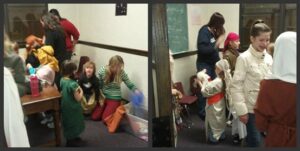
BEGIN!!!
All the angels wore their costumes. WOW!! All the headpieces stayed on, except for our happy little shepherd, who still smiled broadly as she said, “We are afraid!” Joseph and Mary were still not thrilled.
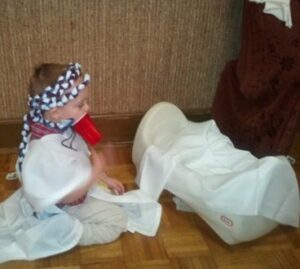 The little angel who wanted to say “Point to the star” wouldn’t leave his dad’s side and come on stage until all the other angels left the stage, and the shepherds were on their way in. Then he went and sat by the baby Jesus and made happy boy sounds with his plastic cup! (This was my grandson, Jack, age 3.) As the shepherds, wise men, and angels gathered around the baby Jesus, it was a mob, juggling each other for a space, mostly with their backs to the audience.
The audience sang loudly as each carol was introduced. Parents smiled, children felt good, and hearts were touched. Eyes were wet. The play was reasonably well run. Cindie was happy, despite being tired. What mattered had gone perfectly. Every child had a wonderful time. They each experienced something new. They felt proud and happy. The spirit of the season was abundant. Ah, success!
When we work with children, whether in a play, doing a craft, or baking, etc., we need to be prepared for childlike behavior. The more open we are to letting kids be kids and working gently and joyfully with them, the better the outcome will be. We will walk away happy and fulfilled, rather than drained. We won’t mind the mess, the silliness, or what doesn’t go as planned. That was the brilliance of Cindie’s vision. This is what being present with kids looks like.

 Here’s a true story. A father was painting the outside of his home. His five-year-old son wanted to help. So this good father gave his son an old shirt with the sleeves rolled up several times. They both went to work on the door, dad painting the top and son painting the bottom. It just happened to be the door to the main entrance.
 necessary for my father to complete the work he was engaged in. I was the beneficiary, as through these experiences I came to know him and to love him. I came to know about a