
 One of my favorite books is Great Expectations by Charles Dickens. I’ve read it a number of times and seen several movie versions. I first read it in high school, and while most of my peers were bored stiff, I was mesmerized by the writing, the language, and the humanness and tragedy of the characters. There are many themes in the book, but today I’m picking a plain, surface one: expectations can halt our progress.
When we have an idea of how something ought to look, feel, or work out, and it isn’t exactly that, we often stop. We can’t see how to move forward, or how to have success because of the perceived roadblocks in our way.
That’s true when it comes to setting up a Spark Station to enhance your family’s activities and learning. Many of us picture a special closet, set of shelves, or deep drawers close to where we spend much of our family time, with fun materials tucked away so anticipation stays high. It would be wonderful if we all had that. The reality is that for most families it won’t look like that. Even so, people go to great, and sometimes silly, lengths to play out the picture.
Some Examples to Smile At
A mom I was coaching wrote to me and said she was stuck. She had picked a spacious closet at the back of a dark storage room, but the kids were afraid of the room. She was considering a dresser and shelves in the family room instead, but then the materials would be available even when the family wasn’t ready to use them together. “I’m frozen by this decision,” she wrote. “Silly, I know, but I can’t get past it.”
I told her dark storage rooms are no laughing matter (my grandmother had one, so I know!). I suggested she use the dresser and shelves in the family room. If you have very small children, a safety lock works, and so does looping a rubber band over the knobs or tying the drawer handles together. Any child over four or five can learn to stay out unless the family is engaging in an activity. Once they feel the excitement of anticipation, they’ll respect the rule and keep it special.
Another mom started her Spark Station in a cold, dark, spider-filled cellar with no lights, and her family slowly stopped using it. No wonder! She had a dresser in her family room that she’d been saving until she could make it “perfect.” After reading the first mom’s note that I shared on the website, she wrote, “Does it really matter what kind of container you keep your materials in?” My answer is a resounding NO! What matters is that you use it as a family and stay present. That night she cleaned out the dresser and moved the fun in. It took about 45 minutes. As a bonus, she said, her kids no longer had to wear gloves when they used their Spark Station. Ya gotta laugh.
I love both stories. Mothers and fathers work hard to connect as a family and learn together. They just don’t always know how, or they strive for perfection. Remember, a workable Spark Station isn’t about where you store your materials; it’s about creating magic. A plastic tote, a dresser, a basket on a shelf, or a closet, they all work if your family engages regularly and parents stay present.
It’s the Wheels and the Gas
Think of a Spark Station as a classy car. The contents are the leather interior, the bucket seats, the fine radio, and the V6 engine. It’s everything that makes you want to get in and drive. But if your wonderful car has no wheels and no gas, you will soon tire of sitting in it waiting for something wonderful to happen.
The wheels for any Spark Station are four of the Five Principles of Power: structure time and be consistent, be present, make it special, and keep it simple. The gas is the fifth principle: plan ahead. Those are the only absolutes. Everything else is based on what you need, what you have available, and what works for your family.
Teach the Way They Learn
You may have heard, “If they don’t learn the way you teach, teach the way they learn.” The same is true for how you use your Spark Station.
My daughter Jodie’s Spark Station was a group of tubs in one corner of the family room. When the kids chose a tub, Jodie tried to help each one engage with the contents. At the time, she had a four-and-a-half-year-old, Maggie, with special needs, a three-year-old, Jack, and a one-year-old, Mary. It was sometimes chaotic.
When I visited again, the tubs were gone. I asked Jodie if she wasn’t using her Spark Station anymore. “We are,” she said. “I now have it in the hall, and I pull things out one at a time, depending on what the activity is.”
I asked why she made the change. “Well, my children are little, and Maggie has special needs. It doesn’t work for each one to play with something different, because they all need my immediate attention. I need to play with them the whole time. We’ve discovered it works best when we all play together, doing the same thing. I suspect we’ll do this for a while.”
How the New Spark Station Worked
It had been a busy morning of dressing, feeding, and getting to a therapy session. At about 10:15, when they returned home, Jodie said, “Let’s learn something new.” “Yeaaaaa!” was the response. Everyone got a hat and sang a welcome song. Then Jodie brought out a large tub of small plastic toys.
I was amazed at how many ways they found to engage with that one tub. They began with I Spy. “Who can spy a cow?” “Who can spy the pink dinosaur?” “No, that dinosaur is blue. Can you find the pink one?” That went on for about ten minutes. Then the three-year-old began choosing random things, so the game changed. “Look, Jack found a frog.” “Maggie found a horse.” Then it changed again. Each child chose an animal to sing with Old MacDonald Had a Farm, and they sang and made the animal sounds together.
All the while, Jodie kept up a running conversation. “Look, Mom, a sharp tooth!” “Yes, Jack, that’s a tyrannosaurus.” “Maggie found the pink dinosaur. It has a long neck; it’s called a brontosaurus.” “You’re right, Jack, frogs lived when there were dinosaurs, but a frog isn’t a dinosaur.” The talk went on and on, and Jodie stayed present.
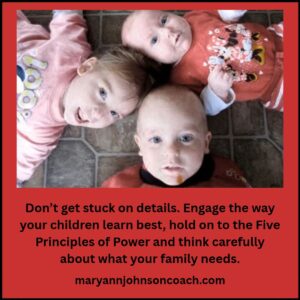
Jodie did the wise thing. She taught the way her children learned best back then, and she held on to the Five Principles of Power while she thought carefully about what her family needed. Her family has wonderful connection moments, and the kids loved using what they found in their Spark Station. It created a magical learning and connection environment in their home.
So don’t get stuck on the details. Choose a space and a container, any container: a basket, plastic tubs, a closet, a dresser, a couple of shelves. Then begin to create magic. Look carefully at your family and see what they need. Remember the Five Principles of Power and stay present.