Tag: love

Peter and the Boy – A True Christmas Story by Lynda Huddleston

My mother had a stroke in February. She wasn’t doing well and was put in hospice. In the ensuing months, she had an astonishing recovery and will be leaving hospice at the end of December. Her current nurse, Laurie, said it’s a joy because it rarely happens.

Our hospice caregivers have been wonderful, and we’ve enjoyed getting to know them. They have made a difference in our lives. This week, we had a visit from Lynda Huddleston, who is the chaplain currently visiting us. She brought a story she had written to read to Mom. It shares a true event that happened at Christmas, when she was working in a care center.

I sat and wept as she read. It was a beautiful example of the gifts we give to others when our hearts have been touched. I asked Lynda if I could share it with you, my readers, and listeners. Thankfully, she said, “Yes.” These will be some of the best moments you spend as we wind down this Christmas season. ENJOY! Merry Christmas.

Peter and the Boy

On the second Friday of the month, in the front room of our assisted living, you could always find music, laughter, and the soft rustle of anticipation—along with most of the ladies leaning in a little closer as Cowboy Andrew began to sing.

Tall beneath his Stetson, with a baritone smooth as molasses, he filled the room with country songs that stirred memories and sometimes tears. Andrew had been part of our calendar long before I joined the staff, and none of us imagined the day would come when he would need us. But when he chose our community for his father, Peter, to spend his last days, we were honored beyond words.

Peter arrived frail and worn from years of illness. When first diagnosed, doctors had given him less than a year to live. Yet when he came to us, he was in his sixth year—still defying the odds. While he was able to enjoy more time with his family during these gifted years, he also endured more than most: the quiet passing of his wife, the dimming of sight in one eye, and the slow betrayal of a once-strong body—the same one that had stood, steady and proud, on countless riverbanks, casting lines beside his boy. Yet through it all, Peter remained fiercely independent—determined to live, and eventually die, on his own terms. Most of us wondered how he had managed to hold on so long, through such battles, but Peter was sure there was something more for him.

We tended to his basic needs at first, waiting quietly, expecting little. But as the days passed and fall deepened, the air turning cooler outside our windows, Peter seemed to gather strength along with the season. Soon, his voice grew lighter, his appetite returned, and his one special request—Diet Pepsi on ice—became a daily ritual.

Even from his bed, his presence still filled the room. A former Air Force officer and instructor, his frame carried quiet authority. We introduced him to the other gentlemen, and before long, his room became a favorite gathering spot. They swapped stories of hunting and fishing, shared memories of service, and laughed over old times. With Andrew beside him, the bond of father and son was plain to see.

Peter never asked for much, but he welcomed the company. We carried coffee hours into his room, complete with cookies—which he enjoyed with such delight that we suspected they meant as much to him as the conversations. Day by day, he taught us the beauty of savoring small gifts.

As December came and we realized Peter would most likely not see another holiday season, we began to look for ways to include him in the festivities. One particular evening, a storm was blowing hard across town. Snow fell thick and heavy, and for a time, we weren’t sure if our visitors would make it. But slowly, car after car pulled in, headlights glowing through the snow, doors flying open as laughing, joyful teenagers poured into our building, brushing snow from their coats.

They were a large local youth group of thirty—too many for one area—so we divided them into six smaller groups. Each rotated through different areas of the building where residents were eagerly waiting—some sang carols, some shared holiday messages, and others told stories about their favorite ornaments. Peter’s room was one of the stops, and I had gathered the men of the building there, along with Peter and his son Andrew.

Before bringing each group to Peter, I paused with them in the hallway. With his permission, I explained what they would see: Peter’s illness showed—he was thin and frail—but he was also very much alive and eager for their company. I told them this would most likely be his last holiday season, and that their presence here, on a cold December night, was a gift beyond measure.

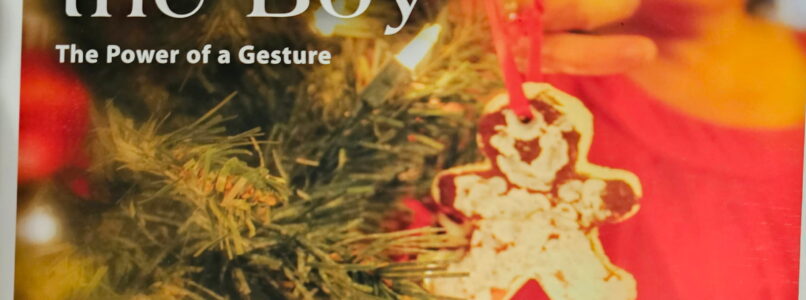
One of the groups was a circle of boys around fourteen or fifteen. Each had brought along a favorite ornament, their faces lighting up as they told the stories behind them. One boy, about fourteen, carried a homemade gingerbread ornament he had made years before. He laughed as he told how every Christmas he had to fight his brothers to keep them from eating it, his voice animated as he relived the battles and the triumph of seeing it hung on the tree each year.

As I watched each group enter and then leave Peter’s room, I was overwhelmed and moved at the understanding on their faces of the significance of those moments. What began as a simple holiday visit was transforming into something sacred, a memory none of us would ever forget.

A night of routine activity was becoming magical.

As the last rotation wrapped up, we gathered everyone, residents and youth, into the front room. All of the residents were sitting in a large circle with the youth surrounding them. As we thanked them all for the stories and treats, we decided to sing a few Christmas carols before they left. The beauty of their voices—young and old, all singing together—filled the room with holiday joy and spirit; overwhelming and touching.

As we were singing, I felt a tug at my shirt. I turned to see the young boy with the gingerbread ornament motioning for me to join him in the dining room. With tears on his face, he asked if it would be okay for him to give his ornament to Peter. The ornament he had fought for years to protect, he now wanted—no, needed—to give to Peter.

I stood watching as he placed the ornament in Peter’s hands, and saw the smile on Peter’s face as he realized how deeply the boy’s heart had been touched in giving him this gift. I was reminded how powerful a simple gesture can be.

Peter hadn’t defied the odds and stayed longer for himself, or because he feared letting go. He had lived a full and good life and was at peace with where he was going. There was simply one more purpose to fulfill.

Peter was here for the boy. To leave a mark that would outlast his own days. To show him, in a way words never could, that a single moment of kindness can echo for a lifetime.

I have no doubt in my heart that this young boy was changed that night—and someday will touch someone else’s heart with the story of Peter and the Boy.

Written by Lynda Huddleston.

Thank you, Lynda, for letting me share.


Lynda is a certified End of Life doula and chaplain for Primrose Homecare and Hospice. The picture is of her and the original gingerbread boy.


The Power of I Love You

Back in 2012, I read an article by Kerry Patterson of the Arbinger Institute, a company designed to build leaders and businesses. He has also helped author several wonderful books designed to help people have better relationships in families, at work, and in communities.  I have enjoyed reading his work for many years. This article, which was published around the holidays, beautifully showcased the power of love. I am sharing it with you because it is powerful. I hope it will bless you and help change your life. : )

The Power of I Love You by Kerry Patterson

Typically, this time of year, I write a piece about the holiday season. This year, I’ve penned a story that took place years ago—during the late spring—nowhere close to the holidays. Nevertheless, even though the tale doesn’t involve presents, or mistletoe, or anything remotely festive, I think it captures the spirit of the season.

The other day, while my three-year-old grandson, Tommy, and I took a walk through the neighborhood, the little guy picked up a rock and tossed it into an irrigation ditch. And then, in the non-sequiturial manner that defines three-year-olds, he looked up at me and whispered, “I love you.” Much to my delight, Tommy tells me this quite often, but on this particular day, there was something about the circumstances that jarred loose the memory of an incident I hadn’t thought about for over half a century.

This particular memory started with what should have been a harmless trip to the grocery store. It was the spring of 1953, I was seven years old, and Mom decided she needed to fetch some milk in order to finish a batch of chocolate pudding. Five minutes later, as Mom, my brother Billy, and I rolled up to the grocery store, Mom spotted her best friend Lydia. “I’m going to be chatting for a while,” Mom barked. “Why don’t you boys play outside with the kids in the neighborhood?”

I was hungrier for snacks than I was for companionship, so I set off in search of discarded pop bottles in nearby gutters. If I got lucky, I’d find a few bottles and trade them in for penny candy. At age eleven, my brother Billy was hungrier for adventure than for sweets, so he set off for points unknown.

After talking with Lydia for nearly half an hour, and with a quart bottle of milk firmly tucked under her arm, Mom stuck her head outside the store and shouted, “Boys, it’s pudding time!”

With the promise of chocolate hanging in the air, I raced back to the store—but Billy was nowhere to be seen. “Go find your brother,” Mother exhorted. “He’s probably down by the creek.”

The creek Mom referred to flowed through the countryside a couple of blocks north of the store until it abruptly disappeared into a four-foot-high cement culvert that carried the water underground for two miles. The tunnel was filthy, dark, dangerous, and chock full of rats. In short, it was boy heaven.

Unfortunately, just getting to the creek posed a serious challenge. The route went past the McHenry house and the McHenry house was filled with stone-cold criminals. The adult McHenrys (when not in prison) were constantly tossing back home brew while feverishly hammering on the pile of rusted auto parts that was their front yard. The McHenry boys, ever anxious to please their parents, cursed, spat, and sic’d their dogs on anyone who had the temerity to breach their territory. I was about to be their next victim.

But I got lucky that day. As I walked toward the creek, the McHenrys were nowhere to be found. Seizing the moment, I dashed passed their den and down to the tunnel entrance. Whew! I had made it!

And then I faced a new challenge. If my brother was, indeed, playing in the culvert, I’d have to shout out a password before he’d let me in. It was kid code. My friends and I were always using secret words such as “Open sesame” to gain entry into our forts or to earn freedom from captivity should the “enemy” lock us up. This system worked quite well except when we changed or forgot the password, which was most of the time.

“Open sesame!” I hollered as I rounded the bend near the mouth of the tunnel. I heard nothing from Billy. “Open sesame!” I tried again, followed by silence and then a resounding “Geronimo!” which also had no effect. Next, I tried, “Montezuma!” Then “Beelzebub!” Still no response. Just when I was about to whip out the granddaddy of all passwords—”Code red!”—I was yanked off my feet and held in the air—thrashing like a gaffed salmon. Craning my head to see who had ahold of my collar, I stared into the face of Chuck McHenry, the oldest and foulest of the McHenry boys.

“Lookin’ for your brother, are ya?” Chuck asked with breath that could stop a bullet. “Cuz if you are, me and my brothers have him trapped.”

Sure enough, a few feet away stood two of Chuck’s teenage brothers. They were throwing rocks into the mouth of the tunnel as if competing in some sort of sadistic carnival game. Eleven-year-old Billy would peek out of the culvert opening to see if the coast was clear and then the McHenrys would hurl jagged rocks at his head.

“Leave my brother alone!” I hollered as I tried my best to kick the McHenry ringleader. Chuck merely laughed. I was seven; he was in his late teens. Fighting was useless. After I tried to break away for what seemed like an hour, Chuck offered up a plan: “If you want us to let your brother go, you’ll have to do somethin’ for it.”

“What?” I asked.

“What do you guys think?” Chuck questioned his brothers. “Should we make him run naked through stinger nettles?”

“Maybe we should hang him by his heels from a tree!” one of his brothers chimed in. “I got it!” Chuck announced as he nodded his head knowingly. I couldn’t imagine what he had in mind, but whatever demented stunt he had concocted, I’d gladly do it. Billy was my best friend, my protector, my big brother.

Then, with a grin that suggested he had just devised the most nefarious punishment ever, Chuck announced: “Tell your brother—in a loud voice—that you love him!” I was confused. This was all he wanted? To tell my brother that I loved him? “Go ahead,” he chided. “Say it! I dare you!” “I love you!” I shouted to my brother.

The McHenry boys then hooted and howled. From their point of view, I had just humiliated myself beyond repair. Right there in front of the whole neighborhood, I, a boy, had been tender and sensitive. Worse still, I had dared to say, “I love you”—to my brother no less! Ugh! As far as the McHenrys were concerned, I had completely disgraced myself.

Finally, after nearly laughing himself sick, Chuck tossed me to the ground and threatened to “pound” my brother and me if either of us said a word to our parents. Then, tiring of the whole affair, Chuck turned on his heels and darted back to his lair—his brothers close behind.

After checking to see if the thugs had really gone, Billy cautiously climbed out of the tunnel, took my hand, and walked me back to the grocery store. “Don’t tell Mom what just happened,” Billy warned. “If you do, the McHenrys will beat us for sure.”

“Plus, if we tattle, Mom will ask us what we learned,” I added. Then we both laughed at the thought. Mom was always asking us what we had learned from our latest debacle and to be honest, I didn’t have a clue what I had just learned. I could say that I had learned not to play in the culvert or go near the McHenrys—but I already knew that.

No matter what we were supposed to have learned that morning, the incident remained locked deep inside my brain until a few days ago when my grandson, Tommy, tossed a rock into a stream and told me he loved me. And then, like an orb tumbling out of a gumball machine, the McHenry memory tumbled out of the dark recesses of my mind and onto these pages.

I’m glad it’s been nearly sixty years since the original event took place because now, I’m mature enough to know what I learned that day. And I’ll be darned if I hadn’t learned it from the most unlikely of characters—Chuck McHenry. The lesson couldn’t be clearer. When threatened by your worst enemy, when going toe-to-toe with the adversary, remember the secret password. Not just any password, but the password.

I love you. It opens all doors.