
 When you’re engaged in a project, what matters to you? For many adults, it’s the outcome. We want the cookies to taste good, the tomatoes to grow large and red, the dress to look store-bought, and the painting to be perfect. I know that doesn’t apply to every adult, but it does apply to many of us.
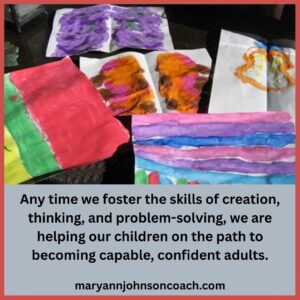
When children are engaged in a project, what matters to them? For the most part, it’s the process. Have you ever watched a five-year-old paint? They like digging the brush deep in the paint and swirling it around. They like lots of paint on the brush. Then they swipe it onto the paper. They smile at the brightness of the color. They aren’t usually concerned if the red bleeds into the green or if the red turns the yellow a tad orange at the edges. It’s the act of painting they care about. And when it’s done, no matter how it turned out, they are happy and proud.
We can increase our joy when working with children if we let go of the outcome. The act of creating is what children love. It’s what makes learning fun. Our job is to provide the materials and the inspiration. Theirs is to create the outcome.
A Party is a Perfect Venue
Any time we can encourage creative exploration, we are on the path to helping our children gain confidence and learn new things. Even a child’s party is a perfect venue for allowing a child to create without worrying about the outcome.
My mom gave me some amazing parties. I recall that in my seventh-grade year, I had a taffy party. I had seven or eight friends over, and my mom taught us to make pulled taffy. It turned out well. It was so much fun. We had a really good time, and each girl had a gift, a plate of taffy, to take home. My mom showed us what to do and then stood back and let us do it.
I followed my mom’s footsteps. One year we had a dress-up party. I collected dress-ups from thrift stores, and when the children arrived, they each designed an outfit. Then we had a wonderful parade around the block. I supplied the materials, and the kids did the rest. I didn’t help them put their outfits together. The outcome wasn’t the priority; creating was.
Another time I helped the kids make sugar cookies from scratch. They frosted and decorated them with small candies, raisins, and other edible treats. Then the cookies were packed into small boxes to take home. I didn’t fix any cookies that didn’t look perfect. It was tempting because what their parents would see might reflect on me. But I shut out that story and let the kids create.
When my youngest daughter was turning eleven, we had a formal tea party. The guests came in their best dresses and were served by mothers who had been enlisted to help. The ice cream was cut into little teapots using a teapot cookie cutter, and each girl had her own miniature cake. They were encouraged to converse. The other moms and I made ourselves scarce and allowed the girls to figure out how a tea party worked. They got the hang of it, and soon there was an ample amount of giggling and chatting going on in the living room. Each girl went home with a miniature tea set purchased at the dollar store. Kate said it was her favorite party.
One year my son had a relay party. All the activities were relay games. We found lots of ideas by asking his grandparents about games they remembered, games I recalled from my school days, and books from the library. The instructions were given, and then the adults sat on the sidelines and let the kids hash it out. They had a wonderful time.
What Would I Do Differently?
Although I stood back and let the children at the party do their thing, here is what I would have done differently if I could go back. I put together wonderfully creative activities, but I did all the planning, just as my mother had done. Wouldn’t it have been a great learning and growing experience to sit down with the birthday girl or boy and plan it together? I bet often they would have loved my idea. Occasionally they might have had a completely different idea, which would have required me to step back and change course, not always an easy thing. But doing that would have helped them work on skills they would need as adults, rather than just showing up at a party and having fun. Think of all the learning that could happen when a child and parent plan something together.
There is real value in stepping back and allowing our children to create without worrying about the outcome. I once read that the greatest teachers replace themselves. When children feel courageous and excited to venture out, learn new things, and then use what they’ve learned to bring joy to others, that’s something worth celebrating.
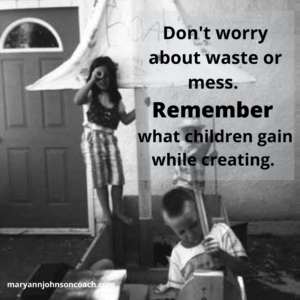 A mother asked me how I handled it when my children wanted to make something that I knew wouldn’t be used after it was created. How did I feel about the waste of resources and the mess that would be left? That is a great question. In fact, this same question comes up often when I am working with moms, and I have put some thought into it and decided that an even better question would be:
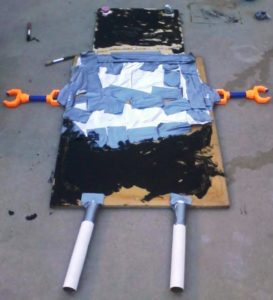 paper roll tubes, and tons of glue, expensive ‘real sticky glue’ as he called it. It turned out spectacularly, but it didn’t have any use. It was too big and not sturdy enough to hang on a wall. It lay on the concrete at the bottom of the back steps to be admired by the whole family until it rained. Then all the pieces were gathered up by an adult and taken to the dump.